Let’s be real for a second. You didn’t open your fitness studio because you deeply love administrative work. You didn’t dream of spending your Sunday nights squinting at spreadsheets, trying to figure out if Instructor Mike taught five classes or six last week.

Let’s be real for a second. You didn’t open your fitness studio because you deeply love administrative work. You didn’t dream of spending your Sunday nights squinting at spreadsheets, trying to figure out if Instructor Mike taught five classes or six last week.
But here you are. It’s the end of the month, and instead of planning your next great workshop, you’re buried in a mountain of manual tasks. You’re chasing down declined credit cards via awkward text messages. You’re mentally calculating if you can afford that new equipment while staring at a confusing bank statement.
When you’re in the thick of this operational chaos, the idea of adding another monthly expense sounds awful. We get it. When a salesperson pitches your shiny new studio management software, your first instinct is probably to look at the price tag and think, "I can just do this myself for free."
But "free" manual labour isn't actually free. It costs you time, energy, and missed opportunities.
The big question isn't really "Can I afford this software?" The better question is, "Can my business afford for me to keep operating without it?"
Let’s break down the actual Return on Investment (ROI) of dedicated yoga studio software or general fitness management tools, moving beyond the sticker price and looking at the actual value it brings to your chaotic day.
Before we dive into the math, we need to reframe what you are actually buying.
When you look at the monthly fee for studio management software, see it hiring a very efficient, 24/7 employee.
This digital employee handles bookings at 3 AM, reminds clients about their classes so they actually show up, politely asks for updated credit card info when payments fail, and tallies up payroll with perfect accuracy.
If you had to hire a human front-desk manager to do all of those things around the clock, what would that cost you in salary and benefits? A lot more than a monthly software subscription.
The goal of this investment isn't just to organize your schedule; it's to build a foundation that allows your business to scale without you burning out.
To understand if the investment is worth it, we need to look at three distinct buckets where software impacts your bottom line: Time Savings (the invisible currency), Revenue Capture (stopping the leaks), and Client Experience (your reputation).
Bucket 1: ROI of Time Saved (The Invisible Currency)
As a business owner, your time is literally money. Every hour you spend on low-level admin tasks is an hour you aren't spending on high-value tasks like marketing, training staff, or connecting with members.
Let’s look at a typical scenario without software.
You rely on a mix of paper sign-in sheets, a Google Calendar, and Venmo. A client wants to book a spot. They text you. You have to stop what you’re doing, check the calendar, text back, wait for payment, and then manually write them down.
It seems small, maybe five minutes per interaction. But multiply that by 50 clients a week. That’s over four hours just on basic booking logistics.
Now add in payroll. At the end of the month, you sit down with your paper sign-in sheets and a calculator, figuring out who taught what and at which pay rate. That’s easily another 3-5 hours of stressful, error-prone work.
Good class scheduling software automates this entirely. Clients book themselves via an app. Payroll is calculated automatically based on check-ins.
The Math:
If software saves you just 10 hours of admin work per month, and you value your time conservatively at $50/hour, that’s $500 a month in regained time value. For most studios, that alone covers the cost of the software multiple times over.

Bucket 2: ROI of Revenue Capture (Stopping the Leaks)
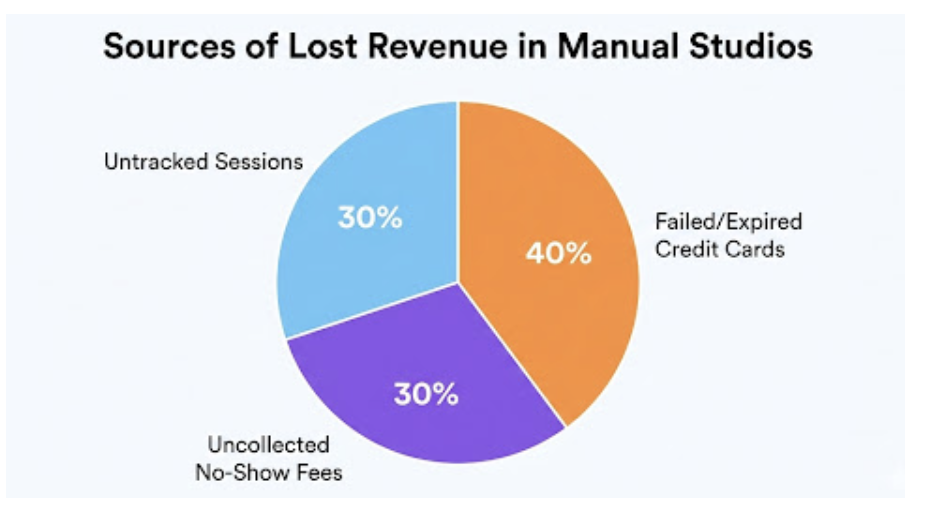
This is where the investment often pays for itself in hard dollars immediately. Without a centralized system, your studio is likely leaking revenue in ways you don't even notice.
Here are the common leaks in a manual system:
Modern studio management software acts like a financial safety net. It automatically retries failed cards and sends polite emails asking clients to update billing info. It sends automated class reminders via text or email, drastically reducing no-shows. It automatically charges no-show fees based on your policy, removing the awkward confrontation.
The Math:
If the software helps you recover just two failed membership payments ($150 each) and enforce five no-show fees ($20 each) in a month, that’s $400 in recovered revenue you would have otherwise lost.
Bucket 3: Client Experience & Reputation Risks
This is the hardest to measure on a calculator, but it’s the most critical for long-term survival.
We live in an era of instant gratification. Your clients are used to booking an Uber with one tap and ordering dinner in seconds.
If booking a yoga class at your studio requires a text message chain and waiting for a confirmation, you feel outdated. You are introducing friction. Friction gives potential clients a reason to look at the studio down the street that has a slick mobile app and instant booking.
The Risk of "Doing Nothing":
Not investing in software isn't just staying neutral; it can actually degrade your reputation.
The Software Solution:
Yoga studio software makes you look bigger and more professional than you are. Clients get a branded app. They get automated "Happy Birthday" emails with a discount code. They get "We Miss You" emails if they haven't visited in two weeks. This automated personalization builds immense loyalty and keeps retention high.
Still on the fence? If you recognize yourself in more than two of these scenarios, the ROI is almost certainly there for you.

When you lay it all out, the question shifts. It’s no longer about whether the software is "worth it." The reality is that running a modern, profitable, and scalable fitness business without it is nearly impossible.
The ROI comes from reclaiming dozens of hours of your life every month. It comes from capturing hundreds of dollars in lost revenue that slips through the cracks of manual systems. And most importantly, it comes from providing a seamless, professional experience that keeps your mats full.
Don't let the administrative weight drag your dream down. It's time to stop working in your business so much and start working on it.