December 22, 2025

The ROI of Switching from Spreadsheets to Yoga Studio Software of Yoga Studio


In a competitive wellness market in 2025 and coming days, yoga studios are no longer evaluated only by the quality of instruction—they are measured by operational efficiency, customer experience, and scalability.

In a competitive wellness market in 2025 and coming days, yoga studios are no longer evaluated only by the quality of instruction—they are measured by operational efficiency, customer experience, and scalability. While spreadsheets once served as a convenient starting point, they increasingly act as a barrier to growth.

This is where Yoga Studio Software and Studio Management Software step in—not merely as digital tools, but as business accelerators. When enhanced with AI-driven capabilities, these platforms deliver measurable ROI by reducing operational friction, improving decision-making, and unlocking revenue opportunities that spreadsheets simply cannot support.

This blog explores the financial, operational, and strategic return on investment (ROI) of making this transition, with detailed examples, implementation guidance, AI use cases, and cost analysis.

1. Why Spreadsheets Fail as Yoga Studios Scale

Spreadsheets are static, manual, and fragmented. As studios grow, the limitations become increasingly visible.

Common Spreadsheet Challenges

  • Manual updates across multiple sheets
  • No real-time availability or booking visibility
  • High risk of data entry mistakes
  • Limited reporting and no predictive insights
  • Poor collaboration between front desk, instructors, and management
  • No automation for reminders, billing, or follow-ups

Business Impact

  • Lost revenue due to missed bookings
  • Overbooked or underutilized classes
  • Delayed financial reporting
  • Reduced customer satisfaction
  • Staff burnout due to repetitive administrative tasks

Key Insight: Spreadsheets track data. They do not manage operations.

2. What is a Yoga Studio Software?

Yoga Studio Software is a purpose-built Studio Management Software with features designed to handle the complete lifecycle of a yoga business—from scheduling and payments to analytics and client engagement.

Core Capabilities

  • Centralized class scheduling and reservations
  • Automated membership billing and invoicing
  • Real-time attendance tracking
  • Instructor payroll management
  • Integrated communication (Email/SMS/App notifications)
  • Performance dashboards and analytics

Unlike spreadsheets, these platforms operate as connected systems, ensuring accuracy, visibility, and automation.

3. Understanding ROI: Beyond Software Cost

ROI is not just about subscription fees—it is about time saved, errors avoided, revenue gained, and decisions improved.

ROI Drivers

  • Reduction in manual labour
  • Increase in booking efficiency
  • Improved member retention
  • Faster reporting and insights
  • Scalability without additional headcount

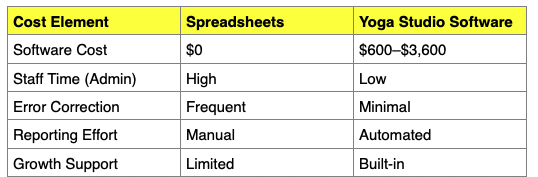
4. Cost Comparison: Spreadsheets vs Studio Management Software

Annual Cost Breakdown (Illustrative estimates for reference)
Hidden Costs of Spreadsheets

  • Staff hours spent reconciling data
  • Revenue loss from scheduling conflicts
  • Missed upsell opportunities
  • Poor visibility into studio performance

5. Quantifying ROI: A Practical Example (Reference)


Scenario: Mid-Sized Yoga Studio

  • 150 active members
  • 6 instructors
  • 40 classes per week

Annual Gains After Switching

  • Admin time saved:
    • 5 hours/week × 52 weeks = 260 hours
    • Average cost $20/hour → $5,200 saved
  • Error reduction (billing & bookings): ~$2,500
  • Increased attendance (8–12%): ~$12,000
  • Retention improvement: ~$6,000

ROI Summary

  • Total Annual Benefit: ~$25,700
  • Annual Software Cost: ~$2,400
  • Net ROI: ~970% (approx.)

6. Role of AI in Advanced Yoga Studio Software

AI elevates Studio Management Software from operational support to strategic intelligence.

AI Capabilities Explained Simply

AI systems analyze patterns across:

  • Booking history
  • Attendance behaviour
  • Payment trends
  • Seasonal demand
  • Member engagement

They then predict outcomes and recommend actions.

7. AI Use Cases in Yoga Studio Operations

7.1. Predictive Class Scheduling

AI analyses:

  • Historical attendance
  • Instructor popularity
  • Time-of-day trends

Outcome:

  • Optimized schedules
  • Fewer empty classes
  • Better instructor utilization

7.2. Intelligent Member Retention

AI identifies:

  • Reduced visit frequency
  • Missed renewals
  • Engagement drop-offs

Automated Actions:

  • Personalized offers
  • Reminder notifications
  • Re-engagement campaigns

“Member activity declining. Suggested action: send personalized class recommendation.”

7.3. Dynamic Pricing and Promotions

AI evaluates:

  • Demand spikes
  • Seasonal patterns
  • Class popularity

Outcome:

  • Premium pricing during peak hours
  • Targeted discounts during low demand
  • Increased revenue per class

7.4. AI-Powered Reporting and Insights

Instead of static reports, managers receive:

  • Trend summaries
  • Risk alerts
  • Revenue forecasts

8. AI Implementation: Step-by-Step

Step 1: Data Readiness

  • Clean historical data
  • Standardize member and class records

Step 2: AI Model Configuration

  • Define goals (retention, revenue, utilization)
  • Select prediction windows (weekly, monthly)

Step 3: Workflow Integration

  • Connect AI outputs to:
    • Scheduling
    • Marketing
    • Billing

Step 4: Monitoring & Optimization

  • Validate predictions
  • Adjust rules
  • Train staff on interpretation

9. Transitioning from Spreadsheets: Implementation Roadmap

Phase 1: Planning

  • Identify current spreadsheet dependencies
  • Define success metrics

Phase 2: Migration

  • Import member data
  • Verify schedules and payments

Phase 3: Training

  • Role-based training for staff and instructors
  • Dashboard walkthroughs

Phase 4: Go-Live

  • Enable bookings
  • Monitor performance closely

10. Data Visualization for Better Understanding

Recommended Visuals in Blog

  • Bar chart: Admin hours before vs after
  • Line graph: Attendance growth over time
  • Pie chart: Revenue sources
  • Workflow diagram: AI-driven scheduling cycle

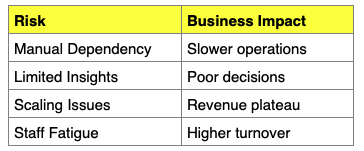
11. Risks of Not Switching


12. Long-Term Strategic Value

Adopting Yoga Studio Software is not just an operational change—it is a long-term investment.

Strategic Outcomes

  • Data-driven leadership
  • Predictable revenue growth
  • Personalized member experiences
  • Competitive differentiation
  • AI-ready future operations

13. High-Impact Conclusion

Switching from spreadsheets to Yoga Studio Software and Studio Management Software like StudioBookings delivers ROI that extends far beyond cost savings. It transforms how studios operate, decide, and grow.

With AI integration, studios move from reactive management to proactive strategy—anticipating demand, retaining members, and maximizing every class slot.


Other articles

Build a stronger, healthier and more profitable studio with us!

Try us free now