
What if feeling depleted isn’t a sign you need to try harder, but a sign your studio’s systems are asking too much of you? If you teach classes, manage bookings, handle client concerns, and solve last-minute problems, it’s easy to feel as though the whole business depends on you. That’s why avoiding...

What if feeling depleted isn’t a sign you need to try harder, but a sign your studio’s systems are asking too much of you? If you teach classes, manage bookings, handle client concerns, and solve last-minute problems, it’s easy to feel as though the whole business depends on you. That’s why avoiding burnout as a pilates studio owner starts with looking at your workload and systems, not blaming yourself for needing a break.
You care about your clients and want your studio to feel supportive. But being available for everyone all the time leaves little room to recover. And when changing your schedule, delegating tasks, or investing in better processes feels financially risky, it can seem safer to keep pushing through.
This guide will help you identify the parts of studio ownership creating the most strain, set boundaries without losing the personal touch, and make a practical recovery plan. You’ll find ways to reduce repetitive admin, share responsibilities more sustainably, and protect time to rest. The goal isn’t to step away from your studio. It’s to build a way of running it that works for you, too.
• Tell the difference between a busy stretch and ongoing depletion by noticing patterns in your energy, focus, and enjoyment of work.
• Map the tasks and expectations that keep you feeling always on, from class changes to client messages and staff coordination.
• To avoid burnout as a Pilates studio owner, address the recurring pressures behind your workload, not just the need for a short break.
• Choose one pressure point to tackle first, test a practical change, and review whether it makes your week more manageable.
• Consider delegation, clearer processes, or studio management software for repetitive admin, based on the work that’s actually weighing you down.
Teaching Pilates can be meaningful work, but meaningful work can still become exhausting when it turns into an always-on responsibility. A packed week or demanding launch may leave you tired for a while. Pay closer attention when the strain sticks around and starts affecting your energy, focus, or enjoyment of the studio. Occupational burnout is described in relation to energy depletion, mental distance from work, and reduced professional efficacy. These ideas can help you reflect, but they aren’t a diagnosis.
Start with a quick check-in. Look for recurring patterns rather than focusing on a single difficult day:
Do you have enough space between classes to reset, prepare, and take care of basic needs?
Are bookings, schedule changes, payments, or client messages regularly taking over personal time?
Do you feel pressure to respond or solve problems immediately, even when they can wait?
Is there dependable time in your week when you’re not teaching or handling studio tasks?
Use this checklist to investigate your workload, not to calculate a score. Note when the patterns began and which workdays feel hardest. That record can help reveal whether a particular class schedule, recurring admin task, or boundary is contributing to the strain.
Notice whether you struggle to switch off after leaving the studio. You might keep checking booking updates, replaying a client concern, or worrying about covering a class. You may also find yourself less patient, motivated, or focused than usual, or enjoying teaching less. These can be signals that your current setup needs attention, not proof of a health condition. If distress feels persistent or severe, consider speaking with a qualified health professional.
Studio ownership often combines several kinds of work. You may teach and plan sessions, support clients, manage schedules and payments, and make business decisions all in the same day. When you’re the main decision-maker, even a routine request can feel urgent because you’re the person expected to resolve it. This pressure can build whether you work alone, coordinate staff, or run a different class model.
Being responsible doesn’t mean every task needs your immediate attention or personal involvement. First, identify what’s draining you most. That gives you a clearer starting point for practical changes.
Owner burnout can take shape when work-related depletion keeps returning and there’s too little time or capacity to recover. It’s not simply a full calendar or one stressful week. Burnout can be an ongoing mismatch between work demands and your capacity to recover.
In a Pilates studio, those demands often overlap. You might teach several classes, adjust the schedule, answer client questions, follow up on payments, and coordinate staff while making decisions about the business. A task that seems small on its own can become draining when it interrupts teaching, planning, or time away from work.
Not every pressure has the same solution. You may be able to streamline a repeated scheduling task or set clearer response times. But client demand, staffing options, and available resources can limit which changes are realistic. Separate what you can adjust from what you need to plan around. This makes the problem more specific and helps you avoid feeling responsible for fixing every constraint at once.
Your class timetable shows when you teach, not all the work that makes each class possible. Count preparation, transitions, programming, follow-up, and admin, too. A class may finish on schedule while client messages or a last-minute change extend your workday. Before reducing or adding class availability, keep a log of a representative workweek. Record teaching and behind-the-scenes hours so any schedule decision reflects the real workload.
Booking questions, cancellations, payment follow-up, and schedule edits can arrive in small bursts throughout the day. Each task may be manageable on its own, but constant interruptions make it harder to focus and can make personal time feel like an extension of the workday. Track which tasks recur, when they tend to arrive, and which truly need your personal attention. Could a clearer process, a designated admin window, or delegated responsibility reduce the interruptions?
If repetitive booking or payment work is a clear pressure point, compare it with what studio management software can handle. For example, Pilates studio management software may help organize scheduling, memberships, payments, and staff management. It won’t resolve every workload or staffing constraint, so start with the task that takes up the most recurring attention and check whether the available tools match that need.
Rest matters. A day away, movement you enjoy, or time with supportive people can help you recover and feel more grounded. But if the same workload is waiting when you return, the relief may not last. Avoiding burnout as a Pilates studio owner means taking care of yourself while also examining what keeps draining your energy.
Adding more classes, marketing, or work hours can seem like the quickest route to better revenue or a fuller schedule. But if your capacity is already stretched, filling every open hour can leave less room for preparation, transitions, and recovery. Before adding sessions, weigh their potential value against the time and energy they require. Class profitability and personal workload both matter.
| Response | What it may help | Limitation | When to reassess |
|---|---|---|---|
| Take a break or protect recovery time | Short-term fatigue and space to reset | Doesn’t remove a recurring workload pressure | If depletion returns as soon as work resumes |
| Add classes or extend work hours | More opportunities to serve clients or earn revenue | May increase demands without creating recovery capacity | Before committing, review the session’s value and energy cost |
| Change a workflow or delegate a task | Repeated admin or responsibilities that don’t need your direct attention | May require planning, resources, or a new process | After testing whether the change reduces the recurring pressure |
Filling every available teaching slot may leave you with little flexibility when a class needs extra preparation or a schedule change comes up. That doesn’t mean adding a class is always the wrong choice. First, consider how it fits your finances, client commitments, and total workload. A timetable change should be a considered business decision, not an automatic response to feeling behind.
Rest, movement, and supportive relationships can all be part of a recovery plan. They aren’t a substitute for changing a workflow that repeatedly takes over your personal time. Pair recovery habits with a practical look at what can be simplified, shared, or scheduled differently. If distress persists or you have concerns about your health, seek guidance from a qualified professional.
There’s no single fix that suits every studio. Reducing classes or changing availability can affect income and clients, so consider those commitments before making a change. Aim for a response that supports your well-being and fits the realities of your business.
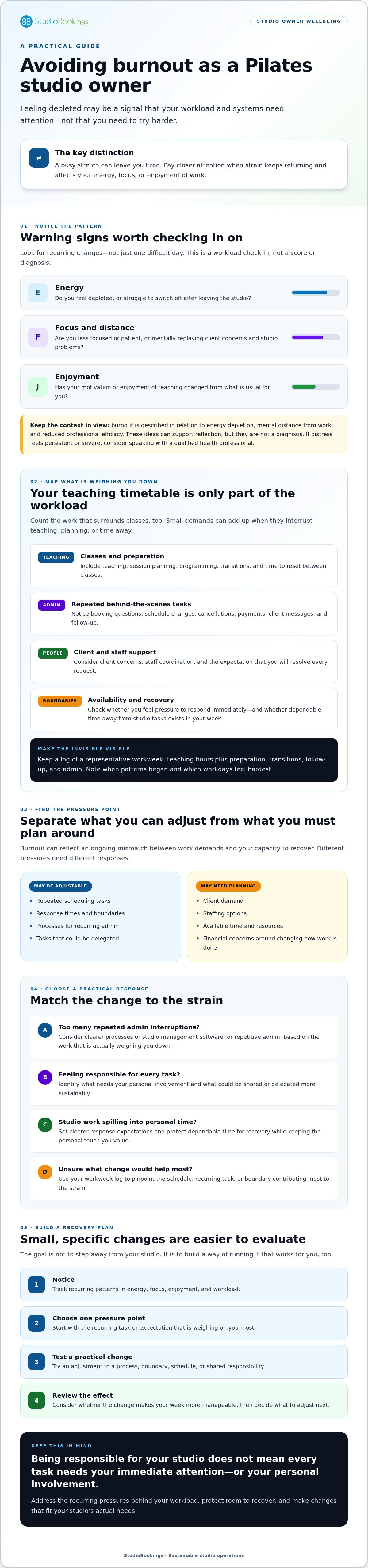
You don’t need to redesign your entire studio to make progress. Start with one recurring pressure point, then make a small change you can observe. A practical approach to avoiding burnout as a Pilates studio owner is to audit your workload, prioritize what’s draining you, test one adjustment, communicate it clearly, and review the result.
For a representative workweek, record time spent teaching, preparing, programming, communicating with clients, changing schedules, and completing admin. Include work that happens between classes and after you leave the studio. A fuller picture can keep you from making schedule decisions based only on teaching hours.
Next, sort tasks by what needs your expertise and what follows a repeatable process. Teaching a client or making a sensitive business decision may call for your judgment. Routine booking updates or payment follow-up may be easier to handle through a documented process, delegation, or a tool suited to the task. Circle one frequent job that interrupts you or causes disproportionate stress. Start there.
Choose an adjustment that’s clear enough to follow. You might set a communication window, protect a planning block, or define a period when you’re not teaching or handling studio admin. If the change affects clients, explain it in advance and set straightforward expectations about how and when you’ll respond. Clear communication can help preserve a supportive client experience while you protect your time.
Keep the adjustment consistent while you test it, then review what changed. Don’t treat one unusually quiet or demanding week as the final verdict. Small, reviewed workload changes can make your next step clearer.
Use a brief weekly check-in to ground your decision in what’s happening:
Which tasks took more time or interrupted your focus?
Which days felt manageable, and which left you depleted?
Did the change affect communication, bookings, or the experience you want clients to have?
Should you keep the change, refine it, or test a different pressure point?
If repetitive scheduling, membership, payment, or staff tasks are taking up too much attention, compare those needs with the capabilities of studio management software before considering a change. Explore Pilates studio management software as one possible way to organize recurring admin. A tool can support a better workflow, but it won’t replace boundaries, recovery time, or a plan that fits your studio.
A sustainable studio doesn’t depend on you carrying every task alone. Support, adjusted expectations, and clearer systems may help make the work more manageable. Start by looking at routine admin one category at a time. The aim isn’t to overhaul your business. It’s to make recurring work easier to handle and protect your capacity for the parts that need your expertise.
Separate your admin tasks before deciding what to change. Booking changes may need a consistent process for handling requests. Membership administration can benefit from clear steps for common updates. Payment processing may be easier to manage when the process is reliable and visible. Staff coordination may call for documented responsibilities and handoffs. If you work without employees, documentation can still make your own routine clearer and easier to repeat.
Delegation can help, but only when someone has the role clarity and capacity to take on the work, and your budget makes it practical. Otherwise, begin by documenting a repeatable process. A simple set of instructions for handling a booking change, for example, can reduce the need to rethink the same task each time. Choose the pressure point that takes the most attention, then decide whether to simplify it, document it, or share it.
Software can bring selected workflows together, but it can’t replace rest, adequate staffing, or professional care when you need it. First, list the admin tasks that recur in your studio. Then compare them with the platform’s capabilities. StudioBookings provides Pilates studio software with scheduling, memberships, payments, and staff management in one dashboard. If those functions match your real bottlenecks, it may be worth exploring. For a broader operational overview, look for a Pilates studio management software guide, too.
The right tool is one that addresses a specific source of repetitive work, not one you adopt because you feel pressured to fix everything at once. StudioBookings offers a free trial, which you can use to assess whether its workflows fit your studio’s needs. List the tasks you want to simplify and check whether the platform supports them before deciding if it belongs in your setup.
Keep the larger goal in view: build a studio that supports clients without requiring you to be constantly available for every detail. Better-defined processes and appropriate support won’t remove every challenge, but they can make ownership more sustainable, one recurring task at a time.
A sustainable studio doesn’t require you to answer every question, teach every class, and carry every task alone. Start by noticing which responsibilities are draining you, then make one manageable change and check how it affects your workload, recovery, and clients.
Avoiding burnout as a Pilates studio owner isn’t about finding a perfect schedule or relying on self-care alone. It’s about matching expectations to your capacity, setting boundaries you can maintain, and simplifying recurring work where possible. Support can take different forms, from clearer processes to sharing tasks or using tools that fit your actual admin needs.
StudioBookings was founded by studio owners in 2012. Its platform brings scheduling, memberships, payments, and staff management together in one dashboard. If those are recurring pressure points for your studio, explore studio management tools that may simplify your admin. A free trial and no-contract pricing give you an option to assess the workflow fit.
You don’t have to solve everything today. A thoughtful next step can help make studio ownership more sustainable, for your clients and for you.
Look for work-related exhaustion, detachment, or a sense that you’re less effective that persists beyond a single busy week. Track teaching and admin hours alongside time to recover, and note changes from your usual baseline, such as difficulty concentrating or less enjoyment of work. These observations can help you decide what needs attention, but they aren’t a diagnosis. If distress continues or affects your health, consider speaking with a qualified professional.
The first step is to map where your time and attention go during a representative workweek. Include teaching, preparation, client messages, schedule changes, payment tasks, and staff coordination. Then identify one recurring pressure point to address first. A specific audit can show whether the strain comes from teaching hours, interruptions, or admin, and gives you a practical place to start instead of trying to change everything at once.
Possibly, if the main pressure comes from something other than class hours. Review preparation, admin interruptions, communication expectations, and whether repeatable tasks can be simplified or shared. Also consider the energy required by different classes, not just the time they occupy. If changing operations doesn’t ease the strain, adjusting teaching hours or seeking support may be worth considering. Weigh any schedule change against your finances, client commitments, and personal capacity.
Set clear, predictable expectations for communication and booking requests, then explain them warmly before a problem arises. For example, tell clients when you typically respond to messages and how they should request a booking change. Apply the policy consistently and make sure it works with your booking process and clients’ needs. Boundaries don’t require you to be distant; they help clients understand how to reach you while protecting time away from studio responsibilities.
Start by listing routine tasks that don’t require your teaching expertise or personal judgment, such as standard scheduling updates or repeat client follow-ups. Before delegating, consider whether someone has the capacity, role clarity, and training to take them on, and whether your budget allows it. If delegation isn’t practical, document the steps or simplify the workflow. A written process can reduce repeated decisions and make a task easier to hand off later.
Studio management software may reduce friction in specific admin tasks, but it can’t prevent burnout on its own or replace rest, staffing, or professional support. First, identify which recurring jobs take the most time, then compare them with the platform’s capabilities. StudioBookings brings class scheduling, memberships, payments, and staff management into one dashboard. Its free trial gives studio owners an option to assess workflow fit before deciding whether the tools suit their needs.
Give clients advance notice, explain what’s changing, state when the new schedule begins, and outline any available options. Keep the message direct and calm, and tell clients how to ask questions or manage their bookings. If possible, review attendance patterns and gather feedback before making a permanent change. Clear communication can help clients adjust, though you can’t guarantee everyone will prefer the new schedule. Consider their needs alongside your capacity and business constraints.