
A new gym commonly takes 12-24 months to break even. A fitness studio profitability calculator for 2026 can help you test how class revenue and ongoing costs affect that timeline, but the result depends on the assumptions you enter.It’s easy to focus on membership revenue and miss the costs that qui...

A new gym commonly takes 12-24 months to break even. A fitness studio profitability calculator for 2026 can help you test how class revenue and ongoing costs affect that timeline, but the result depends on the assumptions you enter.
It’s easy to focus on membership revenue and miss the costs that quietly narrow the margin: instructor pay, rent, staffing, and the effort it takes to keep members coming back. A full class can look profitable on paper, yet still leave little room after expenses.
Assess revenue, operating costs, member retention, acquisition costs, and class break-even. Interpret profit margin benchmarks in the context of your business model instead of treating one figure as the target for every studio. Use the calculations to identify which parts of your operation support profitability and where changes to attendance, pricing, or retention could matter most.
• Map class income against recurring operating costs to see which revenue drivers have the greatest effect on profitability.
• Prioritize member retention: acquiring a new gym member costs 5-7 times more than retaining an existing one.
• Calculate the minimum attendance each class needs to cover its costs, then compare it with the attendance needed to reach your profit goal.
• Compare your net margin with benchmarks for your type of fitness business, rather than relying on a single target for every studio.
• Build startup estimates around the largest expenses, including build-out, equipment, rent, and payroll, to understand the cash needed before opening.
The U.S. fitness industry generated an estimated $45.7 billion in revenue in 2025. Fitness facility membership reached 77 million members in 2024. Those market totals show demand, but your studio’s profitability depends on converting local interest into repeat visits and sustainable class revenue. As of 2025, the proposed PHIT Act had not passed in the United States, according to U.S. Congress.
What local market factors should a fitness studio profitability calculator include? Start with local rent, instructor payroll, class prices, nearby competitors, and the potential customer base within your travel area. Compare demand by class time, too: morning attendance may differ from evening attendance in the same neighborhood.
Monthly recurring revenue gives you a clearer baseline than one-off sales. For example, 100 members paying $100 per month generate $120,000 in annual membership revenue before expenses. But churn changes that picture: annual member churn in the fitness industry averages 30% to 50%, so forecast replacements alongside new sign-ups.
For boutique studios, revenue per member and class utilization show how effectively capacity earns income. Boutique studios should aim for average monthly revenue per member above $200. A 70% or higher average class utilization rate is described as ideal for sustaining profitability. Track visits and payments together, because a membership’s monthly value can differ from its actual class use.
For reformer classes, calculate revenue per reformer-hour by dividing class revenue by the reformer-hours offered. Record paid attendance and collected revenue for each class, then divide by the number of reformers multiplied by class duration. Compare results across time slots. A well-attended class can still contribute less if its price or instructor cost differs.
Costs determine how much of that revenue remains. Rent may account for about 15% of a boutique studio’s revenue, while instructor pay may account for about 25% when classes are full. Facilities and labor account for approximately 70% of fitness studio operating expenses. Model payroll, rent, software, utilities, and payment fees separately to see which costs move with attendance.
What are common financial risks and ways to improve fitness studio profitability? The main risks include weak class fill, rising fixed expenses, and member churn that outpaces replacement sales. Compare class-level income with instructor payroll, adjust schedules around attendance, and work to retain members before relying solely on new acquisition.
Test conservative, expected, and stronger attendance scenarios. Keep membership revenue separate from class packs and other sales, then subtract expenses to estimate operating profit. Update your assumptions as local demand and attendance change, so decisions reflect the studio’s actual revenue mix rather than one headline figure.
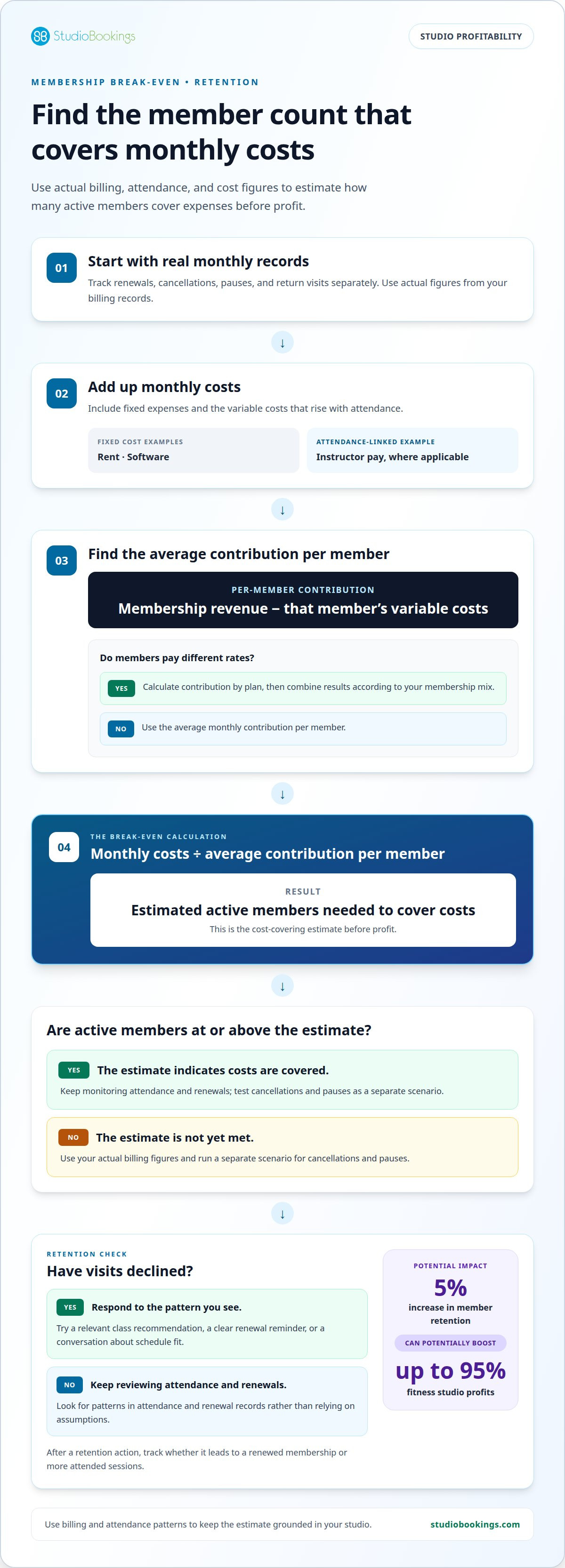
Retention supports predictable revenue because existing members can renew without restarting the sales process. A 5% increase in member retention can potentially boost fitness studio profits by up to 95%. That potential makes retention worth measuring alongside new sign-ups. Track renewals, cancellations, pauses, and return visits separately, so you can see where members leave and which changes may improve loyalty.
Set pricing with your class format, schedule, and local demand in mind. Use market figures as context, not as a direct price recommendation for a boutique studio. Before changing rates, compare membership income with included sessions, class capacity, and instructor payroll.
Premium memberships with 24/7 gym access are one option for facilities that can support around-the-clock access. For a class-based studio, premium value might instead come from added sessions, priority booking, or a wider choice of classes. Define exactly what each tier includes, then compare its price with the service and capacity it uses. Clear terms help members choose the right level.
To calculate break-even membership, total monthly fixed expenses, such as rent and software, then add variable costs that rise with attendance, including instructor pay where applicable. Divide total monthly costs by the average monthly contribution per member: membership revenue minus that member’s variable costs. This estimates how many active members are needed to cover costs before profit.
Use actual figures from your billing records. If members pay different rates, calculate contribution by plan and combine the results according to your membership mix. Run a separate scenario for cancellations and pauses. This gives you a more useful break-even estimate than dividing expenses by a single headline membership price.
Base retention efforts on patterns, not assumptions. Review attendance and renewal records to spot members whose visits have declined. Then try relevant class recommendations, clear renewal reminders, or a conversation about schedule fit. Track whether each action leads to renewed memberships or more attended sessions. That helps distinguish effective retention work from activity that only adds admin.
Revenue streams can also support member value without relying only on recurring dues. Consider whether personal training sessions, workshops, or small-group options fit your timetable and instructors. Keep each offer’s revenue and delivery costs separate, so a popular add-on does not hide weak margins elsewhere. Consistent booking and payment workflows can make membership activity easier to track; studio scheduling tools can support that routine.
A fitness class breaks even when its income covers the costs of running it, with no profit or loss. Calculate this separately from the studio’s monthly break-even point. A Pilates class, for example, has its own attendance, instructor cost, and capacity. This view shows which classes contribute to overhead and which may need schedule or pricing changes.
To find break-even class size, divide class-specific costs by the revenue contributed by each attendee. Include instructor pay and other costs that change with attendance. Divide the result by what each participant pays after discounts or package adjustments. If the class also carries a share of fixed expenses, include that allocation consistently. The result is the minimum paying attendance needed to cover costs.
Break-even is not a profit target. A class goal size is the attendance needed to reach a chosen profit. Add the desired class contribution to costs, then divide by revenue per attendee. Compare both figures with room capacity and actual attendance. If the target exceeds practical capacity, review pricing, instructor costs, or the schedule.
New gyms commonly take 12-24 months to break even overall. A class can cover its direct costs while the studio still operates at a loss because rent, utilities, and other ongoing expenses remain. Track class-level contribution alongside monthly results. This helps distinguish a weak class from a studio still building enough recurring revenue to support its full cost base.
Build a clear cost breakdown before making schedule decisions. Separate fixed expenses, such as rent and software, from variable costs tied to running classes. Allocate shared expenses consistently, for example by class hours or room use. This makes comparisons across formats and time slots more meaningful.
Review figures over a representative schedule cycle, not just one unusually busy week. For each class, record capacity, paid attendance, collected revenue, instructor pay, and cancellations. Compare morning and evening classes, and note whether retention or new-member attendance drives bookings. A class with empty places may still support retention, but keep its financial contribution visible.
Use a fitness studio profitability calculator 2026 worksheet to model class attendance and costs. Test practical changes, such as combining underfilled sessions when schedules allow, shifting classes toward stronger demand periods, or adjusting capacity where equipment permits. Recalculate after each change, since fewer sessions can reduce payroll but may also limit member access.
Keep the fitness studio profitability calculator 2026 projection current as costs, attendance, and the timetable change. Treat it as a running management tool, not a one-time answer. Compare projected results with actual bookings and expenses, then use the difference to refine your next schedule or operating decision.
How do boutique fitness, personal training, and full-service gyms compare in profitability? Typical net profit margins are 20%-40% for boutique studios, 30%-50% for personal training studios, and 10%-15% for big-box and mid-tier gyms at steady state. These ranges are benchmarks, not guaranteed outcomes for an individual business.
The spread reflects different operating models. Personal training studios can earn higher margins because paid coaching sessions deliver focused services. Boutique studios depend heavily on class fill, pricing, instructor pay, and fixed-cost control. Big-box gyms often need broader facilities and staffing, which can put pressure on the margin. Luxury clubs show another range, with typical net margins of 5%-15%.
Other benchmarks add useful context. Micro-gyms and well-run gyms can have different profit margins, depending on their operating models. Boutique studios can also earn approximately $80,000-$140,000 in annual profit. Compare each estimate with the business model and accounting period behind it; a margin percentage and annual profit describe different things.
Calculate net profit margin consistently: subtract operating expenses from revenue, then divide the result by revenue. Multiply by 100 to express the result as a percentage. For example, keep rent, payroll, instructor costs, utilities, and other operating expenses in the same accounting period as the revenue. A monthly calculation helps identify short-term changes; an annual view captures seasonal variation.
For a useful comparison, separate recurring revenue from one-time income and review payroll as a share of sales. Facilities and labor account for approximately 70% of fitness studio operating expenses, so small changes in scheduling or space use can affect the final estimate. Check whether owner compensation is included, too. Different treatment can make two studios’ reported margins difficult to compare.
Choose the benchmark that best fits your format, then investigate the reasons for any gap. A boutique studio below its range might review class utilization, instructor scheduling, and fixed costs. A personal training studio can assess session capacity and trainer payroll. A full-service gym can break down revenue and costs by membership, staffing, and facility operations instead of relying on one blended figure.
Opening costs matter, but keep startup spending separate from ongoing profitability. Track build-out and equipment apart from operating expenses, then estimate how recurring revenue supports monthly operations. Revisit the margin after meaningful changes to pricing, payroll, class schedules, or membership mix. The key is to use business-model-specific ranges as a diagnostic and manage the revenue and expense drivers behind your own result.
The range for a typical U.S. studio reflects equipment and build-out needs, as well as location and studio size.
For reformer studios, equipment quickly shapes the opening budget. Used or marketplace reformers can cost 40-60% less than new equipment. A mix of new and used equipment can reduce equipment costs by 20-30%, though condition and fit still affect the purchase decision.
Build-out and renovation typically account for 50-60% of a gym’s startup budget. Equipment typically accounts for 20-30%, while construction and equipment together represent more than 80% of the budget for most gym builds.
Location changes the estimate. Boutique Pilates studios typically occupy 1,200-2,000 square feet.
Plan cash beyond construction and equipment. Include at least six months of operating expenses in the startup budget, covering rent, payroll, utilities, insurance, and other recurring bills. Separate one-time opening costs from monthly expenses, then compare total funding with your break-even timeline. A studio may open successfully yet struggle if cash runs short before revenue covers expenses.
Opening timelines also affect how long funds must last. Most Pilates studio owners plan 4-9 months from lease signing to opening day. Build a month-by-month cash forecast for that period, then add the operating runway after opening. If the projected break-even point extends beyond available funding, reduce build-out scope, raise more capital, or increase the pre-sale target.
Use local quotes and actual floor plans to replace broad benchmarks in your estimate. Keep assumptions visible so you can update the model as lease terms, equipment choices, and construction plans change. Plan your studio operations alongside the startup budget.
StudioBookings helps yoga studios manage the daily work behind revenue and class scheduling. Its cloud-based software brings class scheduling, memberships, payment processing, and staff management together in one dashboard. This makes it easier to organize bookings and payments while reviewing the figures used in profitability calculations.
For Pilates, barre, fitness, HIIT, pole, or dance studios, StudioBookings offers software tailored to these studio types. It can help when separate tools make operational information harder to organize. Use your attendance, membership, and expense records to assess profitability, then streamline the routines that keep those records current.
Explore StudioBookings at studiobookings.com to see how it fits your studio’s operations.
A profitability model earns its keep when you use it to guide choices, not just record results. Keep assumptions visible and revisit them whenever your schedule, membership mix, or operating plans change. A fitness studio profitability calculator for 2026 can help you compare possible scenarios, but the value comes from acting on what the figures reveal.
Choose an area to improve next, such as class scheduling, membership processes, or how you track studio activity. StudioBookings offers Yoga Studio Software, Pilates and Barre Studio Software, and Fitness and HIIT Studio Software to support studio management. Its unified dashboard helps organize day-to-day information as you assess your business.
Ready to explore whether it fits your studio? Contact StudioBookings to discuss your studio. Take the next step with a clearer view of how your operations support your goals.
New gyms commonly take 12-24 months to break even. Your timeline depends on how quickly membership and class income grow relative to rent, payroll, utilities, and other recurring bills. Build a month-by-month forecast that separates opening expenses from ongoing costs. Then compare projected cash needs with available funding, and update the forecast as actual bookings and member renewals come in.
A Pilates studio can be profitable when class fill, pricing, instructor pay, and fixed costs work together. Boutique fitness studios typically have net profit margins of 20%-40%, but that range is a benchmark, not a personal forecast. Before opening, model attendance by class, equipment capacity, instructor compensation, and rent. A studio with strong demand still needs enough cash to cover quieter periods and regular expenses.
Plan for rent, payroll, utilities, insurance, equipment upkeep, and recurring administrative expenses. Separate fixed bills from costs that change with class volume, such as instructor pay. Build a monthly cash forecast that includes operating expenses during the opening ramp-up, not just build-out and equipment. This distinction helps estimate the funding needed before memberships and bookings consistently cover daily costs.
There is no single useful monthly expense figure for every U.S. studio; costs depend on location, facility size, staffing, and class schedule. Rent and payroll often account for large parts of the budget, while utilities and insurance add recurring costs. List expenses using your own lease, staffing plan, and operating assumptions. Compare the monthly total with expected revenue to identify which costs affect your margin most.
Studios commonly earn revenue from memberships, class packs, personal training, workshops, small-group sessions, and retail. Pricing depends on format, local demand, class capacity, and what each purchase includes, so no single rate suits every studio. Estimate each revenue stream separately. For example, compare membership income with session-based sales, then subtract the direct costs of delivering each offer.
Independent studios don’t share one average margin across every business model. Boutique fitness studios typically report net margins of 20%-40%, while owner-operated, low-cost micro-gyms typically range from 15%-25%. Treat these as category benchmarks, not a forecast for your studio. Calculate your own margin using revenue and operating expenses from the same period, and keep owner compensation treatment consistent when comparing results.
For monthly break-even, divide total monthly operating costs by the average revenue contributed per active member. To calculate monthly profit, subtract operating expenses from total revenue for that month. Keep one-time opening costs separate from recurring results. If memberships, class packs, and training sessions have different costs, track them as separate revenue lines. This breakdown shows whether changes in sales or expenses are improving the overall result.
The number needed depends on monthly costs, average revenue per member, class capacity, and variable expenses. Estimate member break-even by dividing monthly costs by each member’s contribution after variable costs. For an individual class, divide its costs by revenue per attendee to find the minimum paying attendance. Compare that figure with room capacity and actual bookings before changing the schedule or staffing plan.