
Renewals can be a bigger retention test than businesses expect. Member churn is the share of members lost from the group you had at the start of a period: divide those losses by the starting membership and multiply by 100. New signups during that period don’t cancel out the members who left. Effecti...

Renewals can be a bigger retention test than businesses expect. Member churn is the share of members lost from the group you had at the start of a period: divide those losses by the starting membership and multiply by 100. New signups during that period don’t cancel out the members who left. Effective strategies to reduce member churn make it easier for members to get value, stay connected, and renew.
Losing members is frustrating, especially when your studio has something valuable to offer. Retention often improves when the experience feels clear and worthwhile, from a member’s first steps after joining to the renewal process.
This article covers practical strategies to reduce member churn, including clearer onboarding, relevant follow-ups, stronger peer connections, and easier renewals. Adapt these steps to your studio and membership model so retention becomes part of everyday operations, not an afterthought.
• Give new members a clear first step with welcoming onboarding messages and useful guidance.
• Shape retention around your membership model, and use feedback from departing members to spot opportunities to improve.
• Create reasons for members to connect with one another, not just with your business.
• Make renewals easier with timely reminders and clear ways to update payment details.
• Watch for changes in attendance and engagement so you can reach out before a member decides to leave.
Onboarding should help new members feel ready for their first visit. Give them one clear next step, such as completing a profile or booking an introductory class. Make it easy to find the schedule, choose a session, and know what to expect on arrival. A short welcome email can point to the next action and practical help. Keep it focused: too many instructions at once can make getting started feel like work.
An interactive tutorial can guide members through essential tasks, such as finding a class, checking its details, and reserving a spot. Use brief prompts beside the relevant screen instead of a long manual. Let members skip steps they already know, and make help easy to find later. For a yoga studio, a first walkthrough might explain how to choose a class and what to bring. A Pilates studio could show members how to find sessions that suit them.
Build onboarding emails around key moments in the member journey, not a generic run of promotions. Send a welcome message after signup, guidance for the first booking, and a follow-up after the first visit. Give each email one useful purpose. After booking, for example, explain how to prepare for class; after the visit, invite the member to book again. Match each message to the member’s next step, and avoid reminders unrelated to their activity.
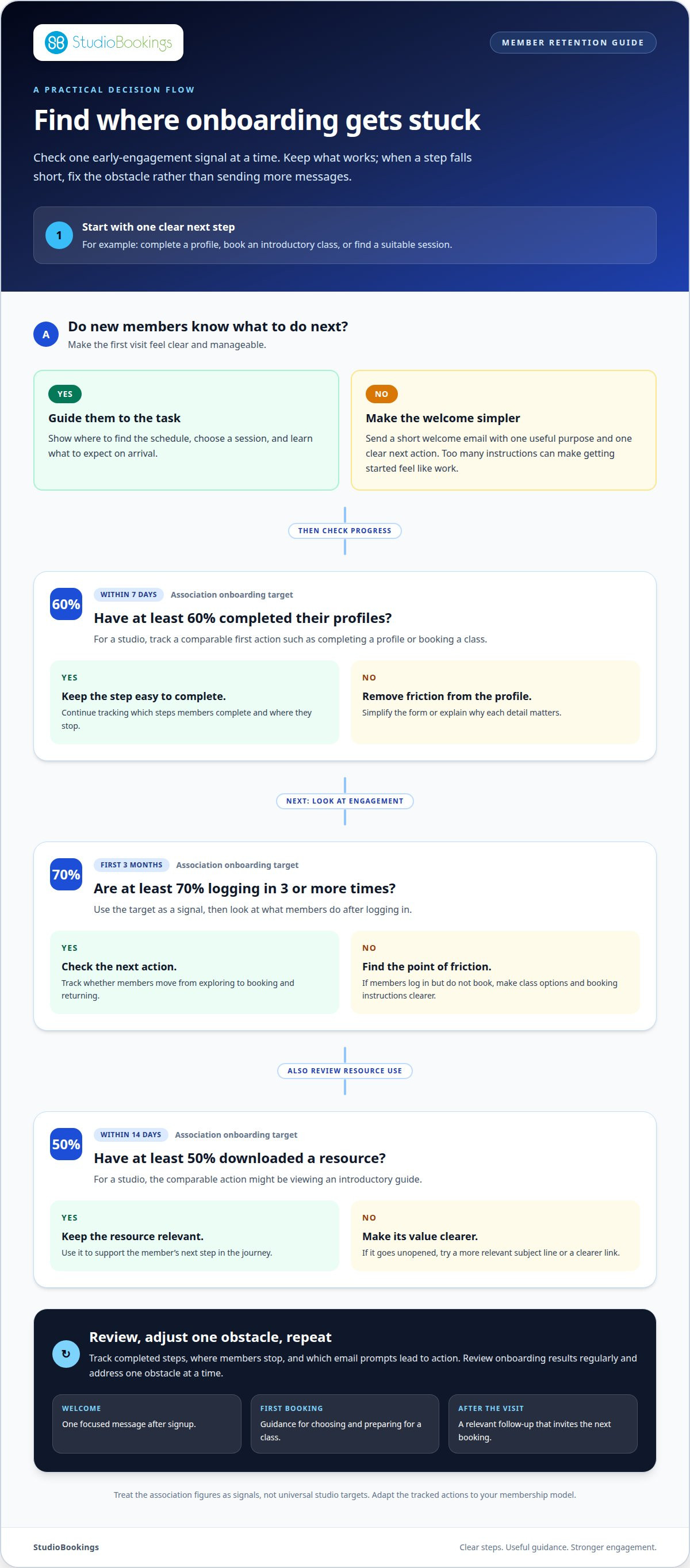
Set measurable early-engagement goals so you can see where onboarding works. Associations can target having at least 60% of new members complete their profiles within seven days. They can also target at least 70% logging in three or more times during their first three months. Another useful benchmark is having at least 50% download a resource within 14 days. For a studio, the comparable actions might be completing a profile, booking a class, or viewing an introductory guide.
Use onboarding targets as signals, not as a reason to send more messages indiscriminately. If profile completion is low, simplify the form or explain why each detail matters. If members log in but don’t book, make class options and booking instructions clearer. If a resource goes unopened, try a more relevant subject line or a clearer link. A short tutorial can explain how to complete a task, while an email can show why it matters.
Review onboarding results regularly and address one obstacle at a time. Track which steps members complete, where they stop, and which email prompts lead to action. A welcome sequence designed to prompt a first booking may need different content from one that encourages repeat visits. Keep the journey easy to follow and provide a direct route to help when a step is unclear. Small, specific changes can make onboarding more useful from signup through the first months of membership.
A useful retention plan starts with the way members buy and use your service. A monthly subscription needs close attention to recurring cancellations, while an annual membership needs a clear view of renewals across the year. Calculate churn by dividing members lost during a period by the members at its start, then multiplying by 100. For example, a subscription service that starts a month with 1,000 subscribers and loses 50 has a monthly churn rate of 5%. New signups don’t offset those losses in the calculation.
Choose a reporting period that matches your business model, then keep it consistent. Churn measures customers lost from the starting customer base over a period. A 10 percent churn rate corresponds to a 90 percent retention rate. Compare like with like: monthly results against monthly results, and annual membership figures against annual figures. Associations often have annual membership churn of 15-25%, while high-performing associations often achieve annual membership churn of 10-15%. Those figures offer context, not a universal target for every studio or subscription business.
Industry benchmarks also vary by customer and product type. A Recurly Research study covering January 2021 to July 2022 reported a median monthly churn rate of 4.75% for software companies and 7.55% for consumer goods and retail businesses. A churn rate between three and eight percent is generally considered acceptable, but acceptable rates depend on the product and industry. Subscription-based B2B SaaS businesses often aim for churn below three percent. Use a relevant comparison to ask better questions, not to copy another business’s retention target.
Use attendance, bookings, renewals, and cancellations together to identify patterns. If members cancel after struggling to find suitable sessions, make class choices easier to navigate. If cancellations follow a drop in participation, reach out with a relevant invitation or ask what would make returning easier. Don’t treat every quiet member the same way: a missed visit may reflect a different issue from a failed payment or an unsatisfactory experience.
Surveys and cancellation feedback can show which obstacles matter most. Ask departing members one clear question about their main reason for leaving, then group responses into themes such as scheduling, value, or experience. Choose a specific improvement based on those themes and review later feedback to see whether the pattern changes. Avoid chasing a generic benchmark, comparing new signups with lost members, or sending the same retention offer to everyone. Measure the change against your own starting churn rate and period, then adjust your approach if the pattern persists.
Connections with other people can make participation feel more personal. In a fitness studio, familiar faces in a regular class can turn attendance into a shared routine. Encourage connections with simple introductions, welcoming class rituals, and chances to celebrate progress. An instructor might invite newcomers to share their names and goals before class, without pressuring anyone to speak. Small, repeatable gestures help members recognize one another and feel included.
Shape community activities around how members already participate. A yoga studio could host a themed practice with time to chat afterward. A dance studio might invite members to an informal showcase or practice session. These activities should complement the core experience, not feel like another obligation. Offer different ways to take part, from talking before class to joining a group activity or connecting more quietly. Giving members a choice helps community feel welcoming rather than forced.
Online spaces can keep members connected between visits. Use a member forum or group for relevant updates, shared goals, and practical questions. A studio could post a weekly class prompt and invite members to share their experiences. Keep discussions relevant to why people joined, and make it clear where they can ask for help. A quiet group may need a more specific prompt, while an active one may benefit from member-led discussions. Useful participation matters more than posting for its own sake.
Associations can target having at least 30% of members active in forums or groups. Treat that target as a prompt to examine participation, not as proof that every member values the same kind of community. Track which activities attract replies, repeat attendance, or introductions between members. If a discussion draws little response, test a more focused topic. If an event brings people together, consider making that format part of the regular member experience.
Make peer connections welcoming to newcomers and established members alike. Introduce a new attendee to a friendly regular, or invite returning members to explain how a group session works. Avoid letting the same voices dominate every conversation. Clear community guidelines support respectful discussion, and a host can draw quieter members in without putting them on the spot. For a first-time visitor, a simple greeting and explanation of what happens next can make joining an established group less awkward.
Connect community efforts to retention signals. Review attendance and participation together, then follow up personally when a once-regular member stops joining group activities. Ask what would make reconnecting easier and suggest a relevant class or gathering. Community should give members genuine reasons to return, not just another place for announcements. Keep improving the activities members actually use.
A renewal should feel like a simple continuation, not a fresh application. Start by showing members their renewal date, membership details, and next action in one clear message. Associations can send the first reminder 90 days before membership expires, then begin the main renewal push 60 days before expiration. These early messages give members time to consider whether their needs have changed. Make the renewal route easy to find, and explain what happens after they complete it.
Use a reminder sequence that builds toward the deadline without sending identical messages. Associations can send another reminder 30 days before expiration and a final reminder 14 days before expiration. Give each message a distinct purpose. The earlier note can explain the value of continuing, while the later one can highlight the steps needed to renew. Include a direct renewal action and clear membership details, so members don’t have to search through old emails or ask staff what to do.
Make renewals straightforward. Remove unnecessary form fields, don’t ask members to re-enter information you already have, and make the next step obvious. A renewal page should clearly identify the membership being renewed and explain how to proceed. If members have to email staff, wait for a response, or repeat details, administrative friction can disrupt an otherwise positive experience. Review the process from the member’s perspective and remove steps that don’t help complete the renewal.
Payment issues can interrupt a membership even when someone intends to stay. Automated email reminders can prompt members to update payment information and help reduce involuntary churn. Use plain language: explain that a payment needs attention, provide a clear way to update details, and state what action to take. Keep the tone helpful, not accusatory. A timely reminder gives the member a chance to resolve the issue before it leads to an unintended cancellation.
Make payment instructions clear throughout the renewal journey. State which membership period the payment covers and what the member needs to do next. If a payment doesn’t go through, send a focused notice rather than burying the action in a general newsletter. Keep renewal reminders separate from class announcements, and make the renewal option easy to distinguish from other links. Clear messages help members act promptly and reduce avoidable questions for staff.
Review where members drop out of the renewal process. Compare completed renewals with reminders sent, then look for recurring obstacles such as unclear instructions, outdated payment details, or a hard-to-find renewal page. If members often need staff help, simplify that step and revise the reminder. Treat renewals as part of the member experience, not just an administrative task. A clear schedule, straightforward instructions, and payment update reminders can help prevent avoidable membership losses.
Use engagement patterns to spot when a member may need a personal check-in. Organizations can flag members whose engagement scores fall 50% or more below their average. That change could show up in fewer visits, less class participation, or reduced interaction with member messages. Define which actions count toward your score, then compare each member’s activity with their own typical pattern. A clear baseline makes an unusual drop easier to recognize.
Set a specific trigger for outreach instead of waiting for a cancellation request. Associations can intervene when a member hasn’t logged in for three months or more. For a fitness studio, a similar signal might be a regular attendee who stops booking. Send a short, personal message that acknowledges the change and offers a useful next step, such as help finding a suitable class. Avoid a guilt-driven tone. The goal is to make reconnecting straightforward.
Orientation and events can give new members a reason to participate early. Associations can target having at least 40% of new members attend an orientation or event within 30 days. Use the invitation to explain what members will learn or who they might meet. For example, a studio could introduce how to choose classes and make a new member feel welcome. Track attendance and follow up with people who didn’t attend, offering another clear way to get involved.
Make messages relevant to each member’s activity. Regular attendees may value schedule updates, while members who have gone quiet may appreciate a simple check-in. Focus each message on one action, such as booking a class, sharing feedback, or joining an event. A generic newsletter can’t replace timely, individual communication when someone’s participation changes. Use email or another established channel, and make it easy for members to reply.
Support also shapes how members feel about staying. Businesses can reduce churn by providing immediate, 24/7 customer support. Where that level of coverage is available, make the help route easy to find and answer the member’s specific question. For teams without round-the-clock support, clear self-service guidance can address common needs, such as locating schedules or understanding booking steps. Don’t send someone through several channels for one simple answer.
Review engagement signals and outreach together. Note which messages receive replies, which invitations lead to attendance, and whether members resume participation after contact. If a check-in gets no response, avoid repeating the same message; try a more relevant offer or ask what would help. Consistent tracking turns communication into a practical retention process, rather than a series of disconnected reminders. To make member activity easier to manage, explore studio management tools.
StudioBookings helps fitness studios manage day-to-day operations that support member retention. Its cloud-based platform brings class scheduling, memberships, payments, and staff management together in one dashboard. Use it to organize studio operations across yoga, Pilates, barre, fitness, HIIT, pole, or dance classes.
When member information, bookings, and payments are easier to manage, your team can give more attention to the member experience. StudioBookings also includes a mobile app for owners and members, making studio services accessible on the go.
If you’re ready to simplify studio management and support a smoother member experience, contact StudioBookings to discuss your needs.
Choose one point in the member journey to improve, such as a confusing step or a moment when participation tends to fade. Decide who will lead the change, what they’ll do, and which member response will show whether it helped. A focused, manageable test gives your team practical feedback to act on.
Effective strategies to reduce member churn start with listening and responding to what members need. Keep communication open, make deliberate improvements, and build on the changes that suit your studio. Retention isn’t a one-time project; it develops through the choices you make in everyday member experiences.
If you’d like support connecting studio operations with your retention goals, start a conversation with StudioBookings. You can explore how its software may fit the way your studio runs and the experience you want to create. Take the next step at a pace that works for your team. Stronger member relationships begin with one thoughtful improvement.
Churn is the share of members who leave during a defined period, compared with the membership at the start of that period. It differs from inactivity: someone who hasn’t attended recently may still be enrolled. For example, distinguish a paused membership from one that has ended. Keeping these statuses separate helps you understand whether you’re losing members or need to re-engage them.
The most effective approach addresses why members leave instead of relying on a single retention tactic. Make it easy to join and participate, offer relevant ways to connect, and remove renewal obstacles. If members say they can’t find classes that fit their schedules, clearer class information may help more than a general discount. Review feedback and activity, then choose an improvement that targets a specific problem.
Divide the number of members lost during a period by the number at its start, then multiply by 100. Track the same period consistently so you can compare results meaningfully. Look for changes that may signal risk, such as a regular attendee becoming less active or an engagement score falling 50% or more below their average. Treat these signals as prompts for a useful, personal check-in, not proof that someone plans to leave.
Members may leave when a service no longer fits their needs, schedule, or expectations. Someone might struggle to find suitable class times, feel unsure how to book, or lose their connection to the studio community. Payment problems can also cause unintended cancellations. Use cancellation feedback to distinguish these causes: a scheduling issue needs a different response from a confusing booking process or a payment detail that needs updating.
Good onboarding helps new members understand how to participate and what to expect. Rather than sending every instruction at signup, guide them through relevant actions in sequence. Explain how to choose a class before sharing optional studio resources, for example. After a first visit, a short follow-up can invite the member to book again or ask for help. This makes early communication useful instead of overwhelming.
Track churn and retention over a consistent period, alongside engagement measures that fit your organization, such as attendance or event participation. Associations often have annual churn of 15-25%, while high-performing associations often achieve 10-15%. Annual churn above 25% can signal systemic problems, and above 35% is considered a crisis requiring immediate attention. Treat these association benchmarks as context, not universal targets for every membership business.
Personalized offers feel more relevant when they reflect a member’s interests. For example, invite someone who regularly attends evening classes to a related session instead of sending an unrelated promotion. Recognition can also support loyalty, such as a personal note acknowledging a member’s milestone. Keep offers clear and useful, and judge them by whether they encourage meaningful participation, not just by how many people redeem them.
Discounts can lower the perceived value of membership if members begin to expect a reduced price before renewing. They may also postpone cancellation without addressing its cause, such as inconvenient scheduling or a poor fit. A broad offer could reward members who planned to stay while overlooking those who need practical support. Before using an incentive, identify the reason for disengagement and consider whether a service improvement would address it more directly.