
What if your busiest dance class is also one of your least profitable? Increasing profit margins for a dance studio starts with looking beyond enrollment numbers. Instructor pay, attendance, and other operating costs all affect what each class actually contributes. If rising expenses and uneven atte...

What if your busiest dance class is also one of your least profitable? Increasing profit margins for a dance studio starts with looking beyond enrollment numbers. Instructor pay, attendance, and other operating costs all affect what each class actually contributes.
If rising expenses and uneven attendance make planning difficult, raising tuition isn’t your only option. Changes that overlook the student experience can put retention at risk, so first identify where your studio earns money and where it loses it.
This guide explains how to measure class and program margins, find opportunities to improve revenue, and build retention into your plan for more predictable income. You’ll also learn practical ways to review costs and assess tools for tracking scheduling, payments, memberships, and staff management. With clearer numbers, you can focus on changes that fit your studio and support sustainable growth.
• Understand the difference between gross and net profit margins, and calculate each using your studio’s figures.
• Compare class revenue with attendance, instructor costs, room capacity, and repeat enrollment to spot opportunities.
• Weigh the effort, risk, and student impact of strategies for increasing profit margins for a dance studio.
• Set a baseline and prioritize opportunities that fit your studio.
• Use studio software to bring key workflows into one place and support clearer decisions, while keeping financial judgment in your hands.
Before changing tuition, adding classes, or trimming expenses, find out how much revenue your studio keeps after costs. Increasing profit margins for a dance studio starts with reliable numbers reviewed consistently. A full class may bring in substantial revenue, but its contribution depends on the costs required to run it.
Profit margin is the share of revenue left after subtracting the expenses included in the calculation. It differs from revenue, the money earned before expenses, and cash flow, which tracks when money enters and leaves your accounts. For a neutral overview of understanding profit margins, see how gross, operating, and net margins relate.
Gross profit margin compares revenue with direct costs tied to delivering classes, such as instructor pay assigned to those classes. It shows what remains before shared expenses are counted. Net profit margin is the percentage of total revenue left after all expenses for the period have been deducted. For a studio, those expenses may include payroll, rent, and other operating costs.
Net profit margin is net profit divided by total revenue, multiplied by 100. A positive cash balance doesn’t automatically mean the studio has a strong margin. Advance tuition payments might boost cash today while related costs are still ahead. A profitable period can also have tight cash flow if payments arrive later than bills are due.
Illustrative example: Imagine a studio records 100 revenue units for a period and 40 units in direct class costs. Its gross profit is 60 units, so its gross margin is 60%. If all expenses total 80 units, net profit is 20 units and net profit margin is 20%. These units are for demonstration only. Use your own figures and keep expense definitions consistent each time you calculate.
Start with a consistent monthly view, then break results down by program or class type. Keep enrollment cycles and seasonal shifts in mind. Compare similar months or terms where possible, so a quiet period isn’t mistaken for a lasting problem.
Track tuition collected, discounts, refunds, and unpaid balances separately. Also note enrollment and attendance to see whether students are paying but not attending, or whether a class is under-enrolled.
Record instructor payroll and other costs directly associated with running each program. Apply your chosen allocation method consistently.
Track rent, administration, and other operating expenses separately. These costs support the studio overall, so assign them to programs only with a consistent method.
Use collected revenue to see what money has come in, but account for outstanding balances and refunds when assessing performance. Once you know which classes contribute and which costs weigh on the studio, you’ll have a stronger basis for deciding what to improve.
With a baseline in place, look at what shapes each program’s contribution: collected revenue, attendance, instructor costs, room capacity, and its place in the schedule. A class can generate strong revenue but require more teaching hours or space than another. Compare these factors before deciding what to change.
Compare typical attendance with the room’s safe capacity and the direct cost of delivering each class. A persistently underfilled class may call for a schedule review, while a waitlisted class could signal unmet demand. Neither is an automatic reason to cancel or add a session. Check instructor availability, student needs, and whether another time or room is workable first.
Separate costs you can adjust from commitments that are fixed or contract-bound. You may be able to revise a schedule or redirect a discretionary expense. Rent or an existing agreement may be harder to change quickly. Recognizing the difference helps you focus on actions within your control instead of counting on savings you can’t readily achieve.
Track enrollment, attendance, renewals, and cancellations across a typical term. If students stop attending before they cancel, the issue may differ from a missed renewal or payment problem. Look for friction in booking, payment, communication, or class continuity, then address the point where students are getting stuck. A clearer membership process can make recurring enrollment easier to manage. Explore this dance studio membership management guide for more ideas.
Retention matters alongside new-student recruitment. Reviewing why existing students continue or leave can reveal practical ways to support repeat enrollment. Focus on providing a consistent experience, not pressuring students to stay.
Use this simple filter to rank possible changes before acting:
Which change could improve class contribution or reduce avoidable costs?
What will implementation require, and when could you see an effect?
Could the change make booking, attendance, or class access harder?
Increasing profit margins for a dance studio doesn’t have to start with a blanket price increase. Consider whether pricing reflects the value students receive. Harvard Business School Online discusses value-based pricing strategies as one approach. Compare pricing changes with schedule or cost adjustments, and prioritize steps that suit your students and operating commitments. If you need a clearer view of administrative workflows, you can also review dance studio software options.
There’s no single fix for every studio. A tuition adjustment may suit a program with steady demand, while an underfilled class may need a schedule review instead. Compare each idea against your class economics, capacity, instructor availability, and student needs. The aim is to improve contribution without creating unnecessary work or weakening the experience students value.
Before expanding, confirm that demand can support another class and that you have suitable space and instructors. Consider tuition in relation to the value students receive, your local market, and how clearly you can explain the change. Workshops or seasonal programs may be worth testing, but treat enrollment and costs as uncertain until you have results.
| Strategy | Likely benefit | Upfront effort | Operational impact | Student-experience considerations |
|---|---|---|---|---|
| Adjust tuition | More revenue per enrollment if students continue | Review costs, value, and local context; communicate the change | Update enrollment and payment details | Explain what tuition supports and give clear notice |
| Add a class | Serve unmet demand or make better use of available capacity | Confirm interest, space, and instructor availability | Add teaching hours and scheduling needs | Choose a time and level that suit students |
| Run a workshop | Test interest in a focused or seasonal offering | Plan the topic, staffing, and enrollment process | Add a short-term program to manage | Make the format and expectations clear |
| Control expenses | Reduce avoidable recurring or unused costs | Review bills, usage, and commitments | May require vendor or workflow changes | Protect teaching quality, safety, and student support |
Review recurring software, supplies, utilities, staffing patterns, and space that sits unused. Separate optional spending from fixed or contract-bound costs, and check actual use before cutting. A cheaper option isn’t a saving if it adds administrative work or disrupts instruction. The SBA guide to managing your business also offers broader guidance on managing operations and finances.
For operational tools, compare your needs with the features and costs of available options. This dance studio software buying guide can help you assess what to look for. StudioBookings brings scheduling, memberships, payment processing, and staff management into one dashboard. Explore dance studio software as one option.
Choose one change, record the expected effect, and compare actual results with your baseline over a consistent period. Increasing profit margins for a dance studio is easier to assess when you can identify which adjustment made a difference and whether students felt its impact.
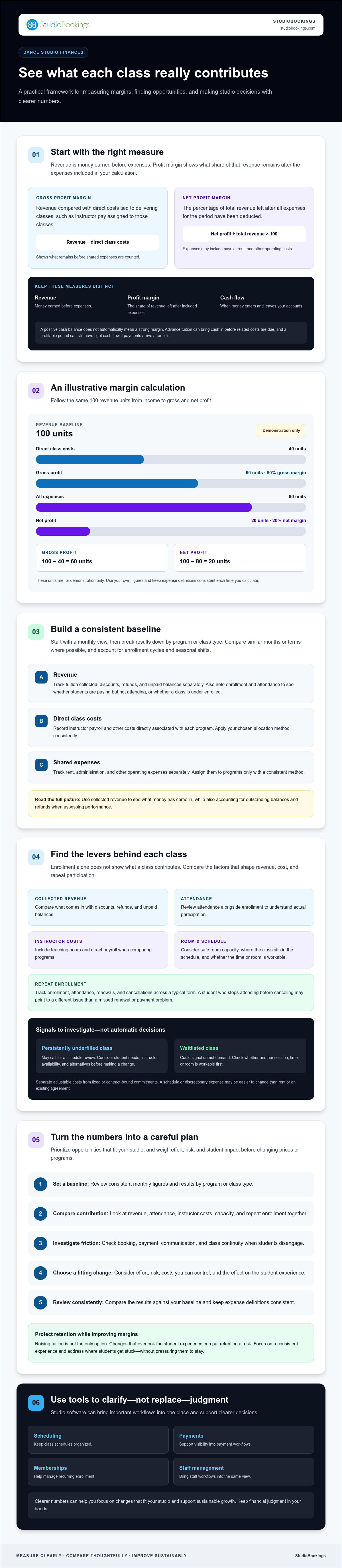
Turn your findings into a small, trackable plan. Increasing profit margins for a dance studio is easier to manage when you focus on one measurable goal, test a change, and check what happened. Avoid changing tuition, schedules, and expenses all at once. If results shift, you’ll want to know which action may have contributed.
Use a consistent 30-day period to gather class attendance, revenue collected, operating expenses, cancellations, and outstanding payments. Compare these figures with a comparable period when possible, especially if enrollment follows seasonal cycles. Then choose one bottleneck supported by the numbers, such as repeated absences in a program or a recurring expense that no longer fits your needs.
Write down your goal, assumptions, the person responsible, and a review date. For example, if you’re testing a revised class time, note why you expect it to help and which attendance or cost figures you’ll monitor. This record makes it easier to interpret results rather than relying on memory.
Keep the test focused. Pilot a schedule, communication, or payment-process change with a clearly defined group or period before rolling it out more widely. Tell affected students and staff what’s changing, when it takes effect, and where to ask questions. Track the financial measure alongside attendance, feedback, and any additional staff workload.
Select an opportunity with a clear link to the issue you identified.
Decide what you’ll compare with the baseline, such as collected revenue, attendance, or an expense.
Name who will carry out the change and gather the results.
Give the test a defined period, then check both intended and unexpected effects.
At review time, compare actual results with your baseline and note what changed outside the test. A dip in attendance, for instance, could reflect a schedule adjustment, but it may also coincide with a term break or another enrollment shift. Record those factors before drawing conclusions. Include any extra administrative work or student friction in your assessment.
Keep what appears useful, revise what needs adjustment, and choose the next action based on what you learned. Studio software can bring scheduling, memberships, payments, and staff management into one dashboard, helping you see everyday processes more clearly. Explore StudioBookings for studio operations as you consider tools that fit your plan.
Once you know which workflows need attention, software can help bring routine tasks into clearer view. Scheduling, membership administration, payments, and staff management may otherwise involve calendars, spreadsheets, and separate tools. Bringing these processes together can help avoid duplicated admin and make follow-up more consistent. Software won’t determine which program is profitable or guarantee better margins. That judgment still depends on your studio’s numbers.
Centralized scheduling can make it easier to review class timetables and manage changes. Membership administration can help keep enrollment information organized, while payment processing can support a consistent way to collect and track payments. Staff management can bring staff-related processes into the same operational picture.
Check what reporting a platform provides before relying on it for decisions. Does it show the enrollment, attendance, payment, and expense information you need? Does that information fit your accounting process? Software can support visibility, but it may not replace accounting tools or provide every report your studio requires. Confirm that it meets your operational and financial needs.
Start with your requirements, not a feature list. Write down the workflows you need to manage, who will use the system, what students or families need from the experience, and what information or processes you’ll need to move over. Then compare platforms against those priorities.
During a free trial, if available, try the scheduling, membership, payment, and staff workflows you expect to use.
Consider whether owners and staff can complete routine tasks clearly and whether the process is straightforward for members.
Confirm that reporting fits your needs and understand how existing records and workflows can be transferred.
Check pricing, contract details, included features, and plan limitations directly with the provider.
For a more detailed comparison checklist, see the dance studio software guide. StudioBookings provides cloud-based software for dance studios, with scheduling, memberships, payment processing, and staff management in one dashboard. As you evaluate options for increasing profit margins for a dance studio, explore StudioBookings and assess whether its workflows fit your priorities.
Stronger margins start with understanding what each class and program contributes, not simply chasing higher enrollment or cutting costs. Track revenue and expenses consistently, then compare opportunities by likely impact, effort, timing, and effect on students. Test one change at a time and use the results to guide your next decision.
Increasing profit margins for a dance studio is an ongoing process. Clearer workflows can help you keep track of the information behind those decisions. StudioBookings offers cloud-based tools for scheduling, memberships, payments, and staff management, along with a free trial and no-contract pricing.
Ready to see whether the workflows fit your studio? Explore StudioBookings for your dance studio. Start with one focused improvement, learn from the results, and build on what works. Steady, informed steps can support growth while keeping students’ experience in view.
Start by measuring revenue and costs by class or program, then focus on the biggest opportunity your figures reveal. Compare attendance with instructor costs and capacity, review cancellations and repeat enrollment, and look for expenses you can adjust without affecting teaching quality or student support. Choose one change, set a measurable goal, and compare results with a consistent baseline before deciding whether to continue or try something else.
There’s no single profit margin that works as a target for every dance studio. Your costs, programs, location, and growth plans all affect what’s realistic. Calculate your net margin consistently, then compare it with your previous periods and business goals. If you use an industry benchmark, check that it comes from a reliable, relevant source and uses the same definition of profit and expenses as your calculation.
It can, if student demand supports the additional class and the revenue collected covers its direct and allocated costs. Before adding a session, assess attendance patterns, room capacity, instructor availability, and scheduling fit. A new class also adds work, so consider its effect on staff and existing students. If demand is uncertain, test the idea with a limited offering and compare actual enrollment and costs with your expectations.
Calculate net profit margin by subtracting all expenses from total revenue, dividing the result by total revenue, then multiplying by 100. For example, if illustrative revenue is 100 units and total expenses are 80 units, net profit is 20 units and the margin is 20%. Use your studio’s figures, define expenses consistently, and distinguish net margin from gross margin, which deducts direct delivery costs.
Not automatically. First check whether current tuition reflects the class’s costs, the value students receive, and your local market context. Consider how a change may affect enrollment, renewals, and the student experience. If you decide to adjust prices, communicate clearly and track collected revenue, cancellations, and repeat enrollment against a baseline. A schedule review, retention improvement, or expense adjustment may be a better fit for your studio.
Software can support the processes behind financial decisions, but it can’t guarantee higher margins or replace your judgment. Scheduling, membership administration, payment processing, and staff management in one dashboard may make routine workflows easier to manage and review. Before choosing a platform, check that its usability, reporting, member experience, and terms fit your needs. Confirm directly with the provider which features and terms are currently available.
Review margins monthly using consistent definitions, then examine results by program or class where your records allow. Also review enrollment, attendance, and renewals across a full term to account for seasonal shifts. After changing prices, schedules, or costs, set a specific review date and compare actual results with your baseline. More frequent checks can help you spot issues, but avoid drawing conclusions from a short period with unusual enrollment patterns.