
What if the price that fills your classes is quietly draining your studio’s margins? Setting rates can feel like a choice between staying affordable and covering the real cost of each session. The right pricing strategies for group fitness classes start with a clearer question: what does it take to...

What if the price that fills your classes is quietly draining your studio’s margins? Setting rates can feel like a choice between staying affordable and covering the real cost of each session. The right pricing strategies for group fitness classes start with a clearer question: what does it take to deliver a class, and what can its capacity reasonably earn?
If you’re weighing drop-ins against class packs or memberships, you’re not alone. A price increase can feel risky when you’re concerned members might attend less or leave. But pricing doesn’t have to be guesswork or a decision you make once and hope holds up.
This guide gives you a repeatable way to calculate a sustainable baseline, choose a structure that suits your audience and class formats, and review rates with confidence. You’ll learn how to factor in delivery costs and capacity, compare flexible and recurring options, and use attendance and revenue patterns to see what’s working. Clear records from your booking and payment systems can help you spot those patterns, so your next pricing decision has a solid footing.
• Use a repeatable cost-and-capacity method to set a rate that supports sustainable class delivery.
• Compare pricing strategies for group fitness classes by how each model affects commitment, predictable revenue, flexibility, and admin workload.
• Test price changes methodically: establish a baseline, adjust one variable, then review the results before deciding what to keep.
• Look at bookings, attendance, capacity use, revenue per class, and repeat visits together for a more complete picture.
• Keep class, booking, membership, and payment records consistent so pricing reviews are easier to act on.
Members want classes that feel accessible and worth returning for. You also need each session to bring in enough revenue to support its delivery. Set rates too low and even a popular class can strain the studio’s finances. Set them without considering member expectations, and a well-designed class may struggle to attract bookings.
A class pricing strategy is the method you use to set, package, and review what customers pay. It covers more than the single-class rate: it includes how classes fit into packs or memberships and how you assess whether those options are working. As Understanding Pricing Strategies explains, pricing choices reflect business objectives. For a studio, the practical task is to connect those objectives to each class’s format, costs, and demand.
One studio-wide rate may not fit every session. A mat-based class and an equipment-based session can differ in setup, instructor requirements, and room capacity. Duration matters, too. A longer class may use more staff time or limit how many sessions you can schedule. Treating every format alike can leave some classes underpriced and make others harder to sell at a rate that reflects their experience.
Keep gross class revenue separate from the amount left after direct delivery costs. Gross revenue is the income attributed to the class before subtracting its costs. The remaining contribution after direct costs, such as instructor pay, room use, equipment, and payment processing, helps show what the session contributes toward broader studio expenses. That contribution is not the same as profit: rent, administration, and other operating costs may still need to be covered.
Sustainable class pricing reflects the experience members value, the number of spots you can responsibly sell, and the costs of delivering each session.
Members may value an instructor’s expertise, clear coaching, a welcoming atmosphere, convenient scheduling, and the motivation that comes from exercising with others. These factors shape perceived value: whether a class feels worthwhile to attend and pay for. That perception doesn’t automatically match your internal costs or financial goals. Use member feedback alongside booking behavior, repeat visits, and cancellations to understand how value holds up over time.
Available spots set a practical ceiling on attendance and the revenue a class can generate. An underfilled session may bring in too little to cover delivery costs, while a consistently full one may still have a narrow contribution if costs are high. Neither attendance pattern proves profitability on its own. Capacity depends on the room, equipment, class format, and safe operating limits, so assess each session against the space and resources it actually uses.
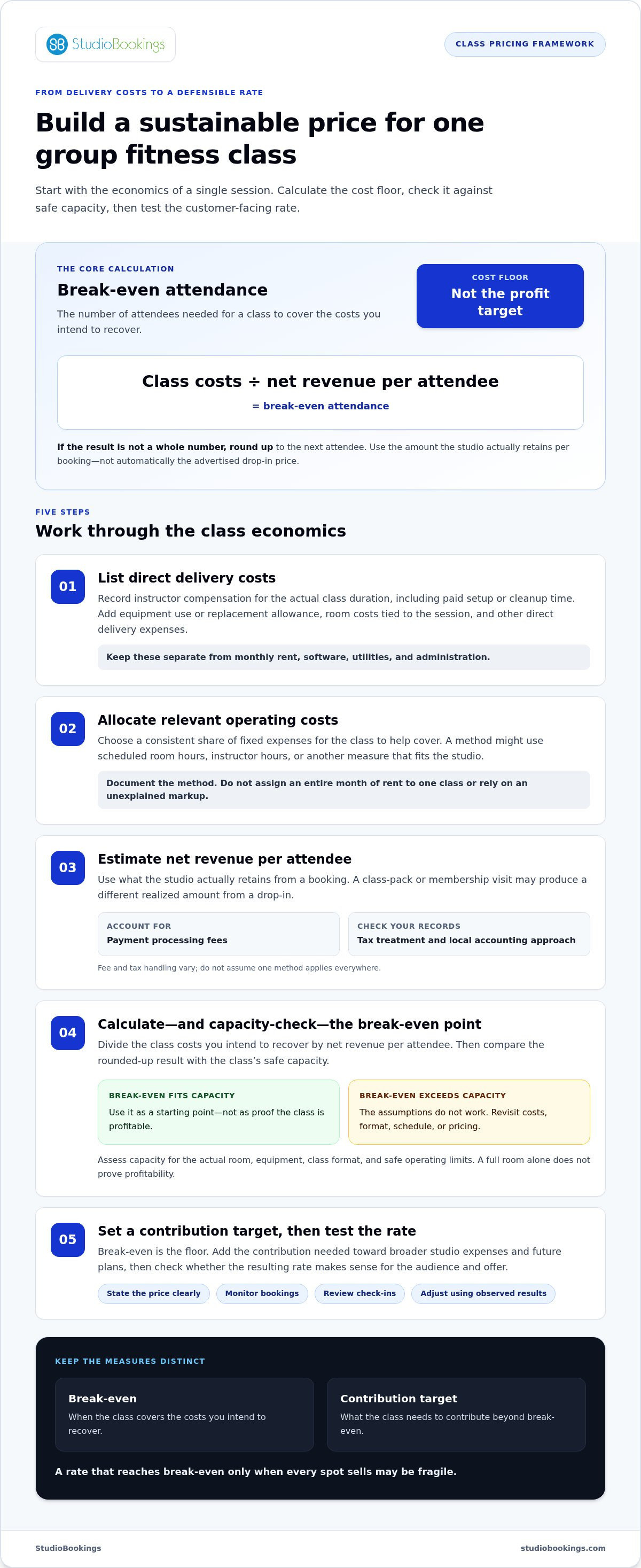
Start with the economics of one session, not a studio-wide average. A class with specialized equipment, a longer schedule, or fewer usable spots can have a different cost and revenue profile from another format. This five-step method gives you a defensible starting point, then leaves room to test the rate against real customer behavior.
Record instructor compensation for the actual class duration, including any paid setup or cleanup time. Add equipment use or replacement allowance, room costs tied to the session, and other direct delivery expenses. Keep these figures separate from recurring monthly expenses such as rent, software, utilities, and administration.
Decide which share of fixed expenses the class should help cover. You might allocate by scheduled room hours, instructor hours, or another consistent measure that fits your studio. Avoid assigning the entire monthly rent to one class, and don’t hide overhead inside an unexplained markup. Write down the method so you can apply it consistently.
Use the amount your studio actually retains from a class booking, not automatically the advertised drop-in rate. A class-pack or membership visit may produce a different realized amount. Account for payment processing fees and tax treatment according to your records and local accounting approach. Taxes and fee handling vary, so don’t assume one method applies everywhere.
Divide the class costs you intend to recover by net revenue per attendee:
Break-even attendance = class costs ÷ net revenue per attendee
If the result isn’t a whole number, round up to the next attendee. If break-even attendance exceeds the class’s safe capacity, the current assumptions don’t work. Revisit costs, format, schedule, or pricing rather than relying on a full room to solve the gap.
Break-even is a floor, not your financial goal. Add the contribution you need toward broader studio expenses and future plans, then check whether the resulting rate makes sense for your audience and offer. State the price clearly, monitor bookings and check-ins, and adjust based on observed results.
Break-even attendance tells you when a class covers its costs; your profit target tells you what it needs to contribute beyond them. Keep those figures distinct. A rate that reaches break-even only when every spot sells may be fragile if the class’s booking history shows regular variation.
Use the session’s actual duration, equipment needs, and safe capacity. Then review its booking and check-in history to set low, expected, and strong attendance scenarios. Apply the same cost and net-revenue assumptions to each scenario. This shows how sensitive the class is to attendance without relying on generic industry benchmarks.
Once your assumptions are clear, consistent class and payment records make the calculation easier to revisit. StudioBookings class and payment management helps keep those inputs organized alongside bookings and memberships.
The right structure depends on how members attend, what your classes require, and how much predictability your studio needs. Drop-ins can suit occasional visitors, while memberships may work better for people who attend regularly. You don’t have to force every customer into one option. Compare the trade-offs first, then choose models that serve distinct needs without making your offer confusing.
| Pricing model | Commitment | Revenue predictability | Access flexibility | Admin complexity |
|---|---|---|---|---|
| Drop-in | Low | Low; depends on each booking | High for occasional visits | Low |
| Class pack | Medium; visits are purchased in advance | More upfront cash, but future use varies | Flexible across eligible classes | Medium; redemptions and expiry need tracking |
| Recurring membership | Higher; ongoing billing | More predictable while memberships remain active | Depends on included access and booking rules | Medium; billing, changes, and access need management |
| Introductory offer | Low during trial | Temporary, not a dependable long-term base | Useful for sampling a defined offer | Medium; limits and next steps need clear communication |
A drop-in gives a member a straightforward way to book one class without an ongoing commitment. It can suit visitors, irregular schedules, or people who want to try a format before choosing a longer-term option. Class packs ask for more commitment upfront in exchange for multiple visits, but buying a pack doesn’t guarantee that every class will be used or that the customer will return afterward.
Set out pack rules in plain language. Explain which classes are eligible, how members redeem visits, and whether credits expire. Apply terms consistently and make sure they comply with local requirements. Clear rules help members understand the offer and reduce avoidable booking questions.
Recurring memberships can make revenue more predictable while members stay enrolled, but their value depends on ongoing use and retention. Match access to actual attendance habits. For example, a regular who books several sessions may want a different option from someone who attends occasionally. Review participation as well as recurring payments so you can see whether a membership supports both member needs and class economics.
An introductory offer can lower the barrier to trying a class, but a trial purchase alone doesn’t demonstrate long-term retention. Define the offer’s eligible classes, duration, and usage limits, then explain what happens when it ends. Make the standard price and membership terms easy to understand before a customer buys.
These pricing strategies for group fitness classes work best when each option has a clear job. A studio might offer drop-ins for casual visits, packs for flexible repeat attendance, and memberships for regulars. Keep the menu manageable, then use booking patterns and customer feedback to refine which choices stay in place.
A price change is a test, not a verdict on its own. Bookings may shift for reasons unrelated to price, so use a consistent review process and consider several measures together. These steps help you judge whether an adjustment supports class performance without relying on a single busy week or a dip in sales.
Before changing anything, note bookings, check-ins, capacity utilization, revenue per class, and repeat visits. Include the class format, time slot, instructor, and any active promotion. Use a period that reflects the class’s normal schedule, and record the same measures you’ll use after the change.
Adjust one price or package condition where practical, such as the drop-in rate or the number of visits in a pack. Changing several things at once makes it harder to tell what influenced member behavior. Keep the class format, schedule, and other offer terms as consistent as you can.
Allow enough time for the class to run often enough to produce a meaningful pattern. A class that meets frequently may provide useful feedback sooner than one that runs less often. Set the review window in advance, and avoid drawing a conclusion from a single session.
Compare the results with your baseline. Consider whether the rate improved contribution after direct class costs while preserving attendance and repeat visits. If the pattern is unclear, continue observing or run a cleaner test rather than treating mixed results as proof.
Bookings show expressed demand; check-ins show who actually attended. Compare both to see whether a price change affected reservations, attendance, or the gap between them. Review capacity utilization and revenue per class alongside contribution after direct costs. Then check repeat visits or membership continuation for signs that customers are responding over time. No single metric tells the whole story.
Compare similar class types and time slots to reduce misleading comparisons. If an instructor, schedule, or marketing push changes during the test, record it: each can affect results independently of price. Tell members what’s changing, why, and when it takes effect. Make the standard terms clear, and honor existing purchase terms so customers know what to expect.
Keep a short review record with the change, effective date, comparison period, and results. Scheduling, booking, membership, and payment records can help you see these patterns together. That makes pricing strategies for group fitness classes easier to refine using actual studio activity, not guesswork.
Use StudioBookings to track class bookings and payments alongside membership activity, so your pricing reviews have consistent records to work from.
A pricing review is easier when the records behind it tell the same story. If class schedules, bookings, attendance, memberships, and payments sit in separate places, you may spend more time reconciling figures than understanding them. Consistent records help you compare similar classes, see how customers use different offers, and revisit decisions with clearer context.
Scheduling and payment tools can make that information easier to review. They help organize operational data, but they don’t choose the right rate for you. You still need to weigh costs, attendance patterns, member needs, and studio priorities. StudioBookings brings schedules, memberships, payments, and staff management together in one dashboard, giving you a shared operational view to support those decisions.
Choose a recurring review cadence that fits your class frequency and operating calendar. A frequently scheduled class may generate useful patterns sooner than a class that runs occasionally. Compare similar periods and formats, and define bookings and attendance consistently. For example, decide whether a booking count includes cancellations or waitlist activity, then apply that definition each time.
Keep a simple record for every pricing change: the date, what changed, why you changed it, and which measures will help you judge the result. That history can show whether a decision was driven by rising delivery costs, weak attendance, or a change in the offer. It also makes future reviews less dependent on memory.
Centralized schedules and payment records can reduce manual reconciliation between class activity and customer transactions. When membership activity is organized alongside bookings, you can more easily understand how different pricing options relate to attendance and revenue. Consistent records also help keep booking, payment, and staff workflows manageable as your offer changes.
Use the findings to keep your pricing menu clear. If a class’s schedule or format changes, record that context before comparing its results with earlier periods. For a broader view of the decisions behind running a boutique studio, the 2026 Essential Guide to Boutique Studio Management offers related operating context. The Yoga Business Software: The 2026 Essential Guide to Studio Growth also explores how business systems support day-to-day studio operations.
Make your next review practical: choose one class, gather its schedule, booking, membership, and payment records, then set a date to assess them using the same measures. This gives your pricing strategies for group fitness classes a repeatable operating rhythm instead of leaving rates untouched or changing them on impulse.
Explore StudioBookings for studio scheduling and payments to keep the operational records behind your next pricing review organized.
Your next step doesn’t need to be a studio-wide overhaul. Choose one class or offer to review, decide what you want it to achieve, and set a date to revisit the results. Treat pricing as an ongoing business decision, not a one-time guess. As your schedule, audience, or class mix changes, the right approach may change too.
Strong pricing strategies for group fitness classes give you room to respond while keeping decisions grounded in your studio’s goals. Consistent records make those decisions easier to explain, review, and refine.
StudioBookings was founded by studio owners and brings class scheduling, memberships, payments, and staff management into one dashboard. With a free trial and no-contract pricing, you can explore how it fits your operations.
Explore StudioBookings and simplify your studio operations, then take the next pricing decision one step at a time. You can build a clearer, more sustainable approach with confidence.
Set a rate that reflects your delivery costs, the class experience, and what your audience is willing to pay. There’s no universal price that works for every studio. As a starting point, calculate the minimum attendance needed to cover class costs, then decide what contribution you need beyond that. Compare your offer with similar local options, but use that comparison as context, not a substitute for your own numbers.
Yes, different rates can make sense when classes require different resources or offer distinct experiences. For instance, a session using specialized equipment may have different delivery economics from a mat-based class. Keep the structure easy to understand: explain what makes an option different, and avoid small price variations that are hard for members to follow. Review whether customers book each format as expected before keeping the distinction.
Neither is automatically better. Drop-ins suit people who attend occasionally or want to try a class without planning multiple visits. Packs can appeal to customers who want flexibility but expect to come back. Compare the realized revenue per visit for each option, and consider whether pack holders actually use their credits. A pack that sells well but rarely brings customers back may not serve your retention goals.
Yes, an introductory offer can give a new customer a lower-friction way to experience your studio, but a first purchase doesn’t prove the offer will create lasting attendance. Track whether customers book again after the promotion and whether they move into a standard option. Make eligibility, usage limits, and the regular price clear before purchase so the offer attracts the right expectations, not just one-time bargain seekers.
Review prices on a schedule that fits your class calendar, and revisit them sooner if a meaningful change affects delivery costs or demand. For example, a new equipment requirement or a shift in class frequency may change the economics before your next planned review. Avoid changing rates in response to one unusually quiet session. Look for a sustained pattern, then document the reason for any adjustment.
A late cancellation fee can discourage last-minute dropouts that leave a reserved spot unused, but it should be easy for members to understand. Set a clear cancellation cutoff, explain when the fee applies, and show the policy during booking. Consider how waitlists and class capacity affect the decision: a released spot may be easier to refill when demand is high. Make sure your terms follow applicable local requirements.
Dynamic pricing may suit classes with consistently changing demand, such as sessions that regularly fill while others have open spots. It can also create confusion if members can’t predict what a booking will cost. If you test it, use simple rules tied to a clear condition, such as booking time or class demand, and communicate those rules upfront. Compare both revenue and repeat attendance before expanding the approach.