
What if Mindbody’s price is reasonable for your studio, but only if you use enough of what it includes? If you're asking, “is mindbody too expensive for a yoga studio?”, the answer depends on more than the monthly subscription. Mindbody’s US Starter plan starts at $79 per month per location, while p...

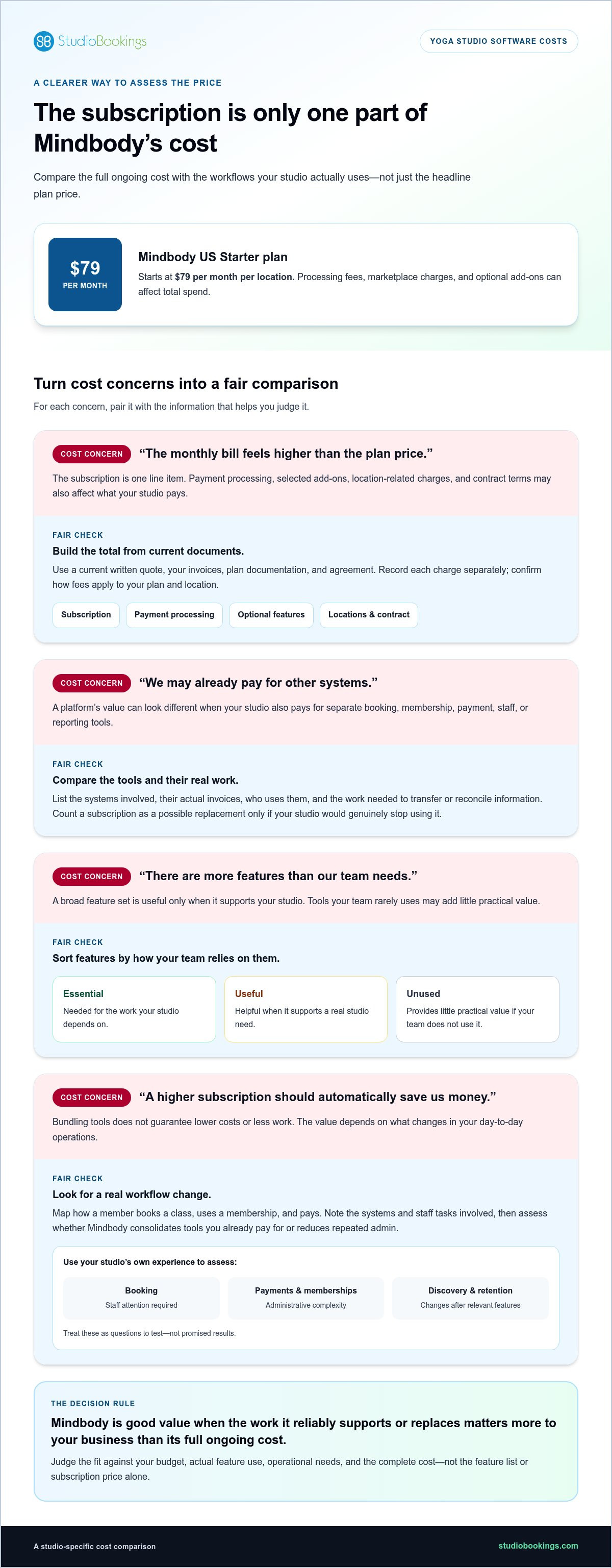
What if Mindbody’s price is reasonable for your studio, but only if you use enough of what it includes? If you're asking, “is mindbody too expensive for a yoga studio?”, the answer depends on more than the monthly subscription. Mindbody’s US Starter plan starts at $79 per month per location, while processing fees, marketplace charges, and optional add-ons can affect your total spend.
It’s fair to feel cautious when the full cost is hard to pin down or a platform offers more tools than your team needs. But comparing software by its headline price alone can also miss the value of smoother booking, membership, payment, and staff workflows. The real question is whether those capabilities save time, support your studio’s goals, or bring in clients.
This guide will help you weigh Mindbody’s current costs against the features and workflows your yoga studio actually uses. We’ll look at subscription pricing, potential extra fees, and the value of its marketplace, then outline a practical way to compare platforms, including StudioBookings, against your needs. That way, you can make a budget decision based on fit, not sales claims or outdated figures.
• Whether Mindbody is too expensive for a yoga studio depends on your budget, actual feature use, and the workflows it supports.
• Build a fair cost picture by reviewing your current quote, invoices, payment processing, optional features, locations, and contract terms.
• Classify each feature as essential, useful, or unused, and note whether it replaces another tool your studio pays for.
• Use your own booking, attendance, payment, and staff data to assess workflow impact instead of relying on assumed savings.
• Compare your findings with options such as StudioBookings, which brings scheduling, memberships, payments, and staff management into one dashboard.
Mindbody is too expensive only if its total cost outweighs the value your studio gets from using it. That depends on your budget, your operational needs, and which features your team relies on in practice. A bill can feel high without being poor value, just as a lower subscription can cost more in staff time if essential tasks remain scattered across separate tools.
Make the comparison between the subscription and related charges on one side, and the value of the workflows your studio actually uses on the other. Consider whether the software makes it easier to manage bookings, memberships, payments, and staff, and whether it replaces other systems or repetitive admin. This is the broader logic of a SaaS business model: recurring software costs should be judged against the ongoing usefulness of the service, not the feature list alone.
A practical definition: Studio software is good value when the work it reliably supports or replaces matters more to your business than its full ongoing cost. Use that standard to assess Mindbody for your studio, rather than labeling it universally affordable or overpriced.
Rent, instructor pay, utilities, and other operating expenses already compete for a place in the budget. A recurring software bill can feel especially noticeable when enrollment changes or quieter periods put pressure on cash flow. That reaction is worth examining, but it doesn't prove the software is poor value.
Mindbody offers a broad range of tools, but breadth matters only when it serves your studio. If your team mainly uses class scheduling and booking, features for other needs may add little practical value. That’s a usage mismatch, not automatic evidence that the plan is badly priced. Keep transparency separate from value, too: difficulty understanding charges can make budgeting frustrating, but you still need to assess what the plan delivers and what you use.
A higher subscription may be reasonable if one platform reduces the effort of coordinating bookings, memberships, payments, and staff. The key is to look for a real change in your day-to-day work, not assume that bundling tools automatically saves money.
For example, map how a member books a class, uses a membership, and pays, then note which systems or staff tasks support each step. If Mindbody consolidates tools you already pay for or reduces repeated admin, those gains may help justify the cost. If it adds capabilities your team rarely touches, the bundle may be less valuable to your studio.
Measure outcomes using your own experience. Track whether booking tasks take less staff attention, whether payment and membership administration is simpler, and whether discovery or retention changes after using relevant features. Treat these as questions to test, not promised results. A clear assessment starts with what your studio needs and uses, then weighs that against the complete cost.
Start with a current written quote for your studio’s country, plan, and number of locations. Then compare it with your Mindbody invoices and the invoices for software you already use. This gives you a studio-specific picture, instead of relying on a price figure that may reflect a different region, package, or contract date.
“Subscription price is one line item; total software operating cost is what your studio pays and spends time managing across the tools it actually uses.” Include the recurring plan charge, payment processing, optional features, location-related charges, and any contract terms that affect what you pay or when you can change plans. Fees and package inclusions can vary, so use your current agreement and plan documentation as the basis for comparison.
Read the plan description alongside your quote. Note which capabilities are included, any limits that apply, and which features carry an additional charge. Then review your agreement for payment-processing terms and other usage-based charges. Don't assume a fee is hidden, standard, or universal; confirm how it applies to your plan and location.
For a clean comparison, record each item separately:
The recurring charge for the selected plan and location.
The terms that apply when clients pay through the platform.
Add-ons your studio has selected or is considering.
Any charges, commitments, or conditions tied to how your studio operates.
This breakdown helps explain why the amount on a plan page may not match the full amount on an invoice. It also makes it easier to compare like with like, rather than weighing one platform’s base subscription against another’s broader total.
List the separate systems involved in running your studio before counting any possible savings. Include booking, membership management, payments, staff coordination, and reporting. For each, note the actual invoice, who uses it, and the work involved in transferring or reconciling information between systems.
Only count a subscription as a potential replacement if your studio would genuinely stop paying for it. If you’d keep a separate payment service or reporting tool, include that cost in the comparison. Also record the staff time spent moving data, fixing duplicate records, or switching between systems. Treat that time as an operational consideration, not a guaranteed cash saving.
If your audit shows that several tools support the same core studio workflows, compare them with an all-in-one option such as studio management software. The useful question isn’t simply “is mindbody too expensive for a yoga studio?” It’s whether your current total spend, contract, and admin burden make sense for the work your team needs done.
Feature count isn’t the same as value. For each capability, ask two questions: does your team use it now, and does it make an important studio task easier? Then check whether it replaces another tool or simply adds another system to manage.
Use a simple scorecard. Base “current usage” on staff experience and observed activity, not what you hope the studio might need later.
| Feature | Current usage | Business importance | Replaces another tool? |
|---|---|---|---|
| Class scheduling and booking | How often do clients and staff use it? | Essential, useful, or unused | Yes, no, or partly |
| Memberships and payments | Which packages and payment tasks run through it? | Essential, useful, or unused | Yes, no, or partly |
| Marketing and reporting | Which tools or reports are actively used? | Essential, useful, or unused | Yes, no, or partly |
| Staff tools | Which scheduling or coordination tasks rely on them? | Essential, useful, or unused | Yes, no, or partly |
Start with the studio’s actual class timetable. If you run varied class types, manage capacity closely, or see clients booking in different ways, assess whether scheduling and booking support those needs smoothly. For memberships and payments, look at the packages you sell, recurring billing needs, and the admin work involved in maintaining them.
Review marketing, reporting, and staff capabilities with the same discipline. A report matters if you use it to make decisions; a staff tool matters if it supports work your team regularly performs. Mark each feature essential, useful, or unused. Don’t give a feature a high score simply because it’s available.
A small or new studio may need a focused set of tools, while an established studio may rely on more detailed workflows. Size alone doesn’t decide the fit. A small studio with complex scheduling may value capabilities a larger studio barely uses. Judge the work, not the label.
Unused features can weaken value, but a bundled feature isn’t automatically wasteful. It may replace a separate tool or remove repeated data entry. Look for evidence: do staff use it, does it save a recurring step, or does its information guide an actual decision? If a capability overlaps another system or staff avoid it because it feels cumbersome, note that too.
Ask instructors and administrators where work flows well and where it gets repeated. Their feedback can reveal friction that a feature list won’t show. If you’re still asking, “is mindbody too expensive for a yoga studio?”, use the scorecard to connect the cost to features your team genuinely depends on, rather than paying for breadth in theory.
Turn the decision into a short audit, using your studio’s records rather than industry averages. Review a representative period that reflects your normal operations, and separate what you can measure from what you’re estimating. The goal isn’t to prove that Mindbody pays for itself at any cost. It’s to see whether the platform’s total cost and practical impact fit your studio now.
Collect Mindbody bills and related charges, plus invoices for your other studio software.
Identify what staff and clients actively use, what they rarely use, and what remains unused.
Use booking, attendance, payment, and staff records to assess where work becomes easier or remains repetitive.
Weigh the full costs and relevant workflows of alternatives against your current setup.
Use evidence you already have. For example, compare booking records with staff notes about manual changes, or review how much time your team spends reconciling membership and payment information. Don’t treat projected new bookings or revenue as guaranteed benefits. If you consider those possibilities, label them as assumptions and keep them separate from results you can verify.
Add recurring software charges and related costs from current invoices. Then estimate time saved only for tasks the platform demonstrably handles, such as reducing repeated entry between systems. Apply a value your studio chooses for that staff time. Compare the resulting estimate with total cost, and clearly mark assumptions so a forecast doesn’t look like a proven saving.
Operational simplicity also matters, even if it doesn’t appear as a line on an invoice. Note fewer handoffs, clearer records, or less duplicate work when you can observe them. Keep those benefits distinct from cash savings; both can inform your decision, but they’re not interchangeable.
A new studio may prioritize reliable booking, membership, payment, and staff workflows without paying for capabilities it doesn’t expect to use. A growing studio can assess whether increasing coordination demands make an integrated platform more useful. An established studio should review actual feature adoption and recurring admin before deciding whether to keep its current systems.
Studio size is a starting point, not a verdict. A small studio with a complicated timetable may need more operational support than a larger studio with a simpler setup. For a size-specific buying perspective, use this guide to yoga software for small studios alongside your audit.
Once you’ve set your criteria, compare Mindbody with software that brings core studio operations together. Explore StudioBookings for studio management as one option to assess against your booking, membership, payment, and staff needs. Then answer “is mindbody too expensive for a yoga studio?” with your own costs and workflow evidence, not a generic verdict.
After assessing which workflows matter and what your current setup costs, compare options against that same checklist. StudioBookings is another option for yoga studios that want core management tasks in one place. Its cloud-based platform brings class scheduling, memberships, payments, and staff management into one dashboard, with mobile apps for studio owners and members.
The aim isn’t to switch simply because one platform has a shorter feature list. It’s to see whether the day-to-day tools match how your studio runs. If you’re asking, “is mindbody too expensive for a yoga studio?”, including another platform in your assessment can help show whether the difference is about price, workflow fit, or both.
Return to the tasks you marked as essential. If your audit focused on organizing classes, handling memberships and payments, and coordinating staff, compare how those needs map to StudioBookings’ core capabilities. Consider the owner and member mobile apps as part of the overall experience your team and clients would use.
A free trial gives you a way to assess workflow fit before deciding whether to make a longer-term change. Use it to test relevant tasks, such as setting up a class schedule or reviewing how membership administration fits your routine. StudioBookings also offers no-contract pricing, giving studios another factor to weigh as they consider commitment alongside functionality.
Keep your comparison consistent. Use the same categories for both platforms: the features your studio needs, how often you’d use them, the complete costs based on current terms, and the effect on daily work. Note where a platform supports an important task, where it overlaps with another tool, and where a capability doesn’t fit your current priorities.
For a closer look at the options, see this Mindbody alternative comparison for yoga studios. It can help you frame the platform decision, while your own audit remains the best guide to which features matter to your studio.
You don’t need to decide based on brand reputation or a feature checklist alone. Compare each platform against your real workflows, then choose the setup that makes the important work manageable for your team. If StudioBookings’ capabilities match your priorities, explore StudioBookings studio software and see whether it fits the way your yoga studio operates.
Your software decision doesn’t have to be a verdict on which platform is best for every yoga studio. It’s a choice about what helps your team run classes smoothly at this stage, and whether the cost makes sense for the work it supports. Revisit that fit as your schedule, team, and operating needs change.
If your comparison points toward a simpler workflow, StudioBookings offers a practical option to explore. It was founded by studio owners and now serves studios in more than 40 countries. A free trial and no-contract pricing give you room to assess the fit without treating the decision as permanent.
So, is mindbody too expensive for a yoga studio? The answer is the one your own usage, costs, and priorities support. Choose with confidence, based on what your studio needs next, not pressure to use every feature or follow someone else’s recommendation.
Explore StudioBookings and try a simpler way to manage your studio. Your next step can be a practical test, and your best-fit system should make running your studio feel more manageable.
It can be, if the features your studio relies on justify the full cost and help manage real operational demands. The question “is mindbody too expensive for a yoga studio?” is especially relevant if you use only a few of its tools. For example, a studio running a simple timetable may value booking and payment workflows most, while a small studio with varied memberships or staff coordination needs may benefit from more capabilities.
The current pricing information available for this comparison doesn’t establish whether Mindbody offers a free trial. Check its current signup terms for your region, and distinguish a product demo from hands-on trial access. Before proceeding, confirm the trial’s length, which features are available, whether payment details are required, and when paid billing would begin. That way, you can evaluate the product without mistaking a demonstration for a trial.
Yes. Mindbody pricing varies by country, and the quoted amount may also depend on the plan and number of locations. A figure advertised for one market may not apply to a studio elsewhere. For an accurate budget, use a current quote for your country and setup, and check whether it covers every location you plan to manage. Compare that quote with your invoices, not an older estimate from another studio.
Don’t assume processing fees are included in the subscription. Mindbody Payments is integrated, but processing rates vary by plan and aren’t publicly listed in the pricing information used here. Review your agreement and recent statements to see which payment charges apply to your studio. Separate recurring software charges from transaction-related costs so your monthly comparison reflects actual activity, rather than treating the subscription as the complete cost.
Whether Mindbody will negotiate depends on the current offer and your circumstances, so don’t assume a particular discount or contract term is available. Before discussing renewal or a new agreement, identify the plan, locations, add-ons, and commitment period your studio needs. If you receive revised terms, compare them in writing with your existing agreement and note any changes to fees, renewal timing, or cancellation conditions.
Review your renewal date and any notice period in the agreement so you know when a decision is due. Check for changes to subscription terms, payment processing, locations, add-ons, or included features. Then consider whether staff still use the tools you’re paying for and whether the current setup supports your class schedule and membership administration. Record questions and requested changes before renewal, and keep the final terms with your studio’s budget records.