
What if your most valuable yoga client isn’t the one who spends the most this month, but the one who keeps coming back? Learning how to calculate client lifetime value yoga studio owners can use starts with looking beyond a single payment and understanding what clients contribute over time. To get a...

What if your most valuable yoga client isn’t the one who spends the most this month, but the one who keeps coming back? Learning how to calculate client lifetime value yoga studio owners can use starts with looking beyond a single payment and understanding what clients contribute over time.
To get a useful estimate, decide what revenue to count, how to treat costs, and when a client relationship begins and ends. Memberships, class packs, drop-ins, and retail can all affect the result, but only if you include them consistently. A reliable CLV is not a borrowed benchmark or a guess dressed up as a formula. It is an estimate built from your studio’s own client records, with assumptions you can review and adjust.
This guide covers the key formulas, the revenue and cost figures to include, and practical ways to estimate client lifespan. You’ll see how different assumptions affect the result and how to use CLV in retention and business planning. Organized membership and payment records can make the inputs easier to assemble. The formula helps you decide what those figures mean.
• Choose revenue-based or profit-based CLV based on the decision you want to make, and define which costs belong in the calculation.
• To calculate client lifetime value for a yoga studio, define active and lapsed clients and compare consistent client cohorts.
• Estimate client lifespan using clear observation windows, then review how different assumptions affect the result.
• Use a step-by-step calculation to turn your studio’s client data into a practical estimate, not a universal benchmark.
• Pair CLV with retention, capacity, and acquisition information, then test one focused retention change with a defined cohort.
Client lifetime value (CLV) estimates the value a client contributes to your studio during their relationship with it. It looks beyond a single visit or payment. Before calculating it, decide what “value” means for the business question you want to answer.
Revenue-based CLV estimates the revenue associated with a client over a chosen period or their full relationship. Profit-based CLV estimates the contribution left after subtracting the costs you include. Revenue can help you understand sales potential; profit-based CLV can help you assess what remains after selected direct costs. Choose the measure that fits your decision, and label it clearly.
For example, imagine a member pays 100 units each month and stays for six months. One payment represents a single month. A simple revenue-based estimate for the relationship is 100 multiplied by six, or 600 units. That is cumulative revenue, not profit, because expenses have not been deducted. The figures are hypothetical and assume the payment stays the same throughout.
CLV involves more than multiplication. You need clear rules for what counts as revenue, which costs to subtract, and how long a client relationship lasts. The Customer Lifetime Value (CLV) concept has several calculation approaches. Record the method you choose and apply it consistently when comparing results.
Revenue-based CLV connects average client revenue in a set period with the number of periods a client remains active. For purchase-based revenue, frequency helps explain how often clients buy and how much they spend each time. A profit-based estimate adjusts revenue for a defined set of costs. If you include class packs or retail alongside memberships, identify each source and count it consistently.
CLV can help you plan retention efforts, assess membership offers, and consider whether expected client activity fits available class capacity. It also gives context for acquisition spending by helping you compare the cost of bringing in a client with the value estimated by your chosen method. There is no universal target that suits every studio.
Treat the result as a planning estimate, not a promise of future revenue. Membership changes, pauses, and client departures can all affect what actually happens. Review your assumptions before making decisions. Organized membership and payment records can help you assemble client activity data, while studio management software can support that record-keeping. Your definitions and formula determine what the resulting CLV figure means.
Choose a formula that matches the decision you’re making. Revenue-based CLV estimates the revenue a client generates over an average relationship. A profit-oriented estimate adjusts that value for selected direct costs. Keep the measurement period consistent: if average revenue is monthly, measure client lifespan in months too.
First, calculate average client revenue for a defined period. Then multiply it by average client lifespan, measured in the same periods. For a hypothetical example, say a cohort generates 120 revenue units per client per month and stays for an average of eight months. Revenue-based CLV is 120 × 8, or 960 revenue units per client. These illustrative units are not a studio price or benchmark; they show how the formula works.
| Estimate | Formula | Required inputs | Useful for |
|---|---|---|---|
| Revenue-based CLV | Average revenue per client per period × average lifespan in periods | Consistently defined revenue and lifespan | Comparing revenue estimates across cohorts or offers |
| Profit-oriented CLV | Revenue-based CLV × gross margin | Revenue-based CLV and a defined gross margin | Estimating contribution after selected direct costs |
Start by defining the revenue included. You could count membership payments only, or also include class packs and drop-ins. Apply the same rule to everyone in the cohort. Several CLV formulas are used, so label yours and keep revenue and lifespan periods aligned.
Revenue alone doesn’t show what remains after delivering classes. To estimate contribution, multiply revenue-based CLV by gross margin, the share of revenue left after the direct costs you’ve chosen to count. For example, a hypothetical 60% margin applied to 960 revenue units gives 576 contribution units. The result changes with the costs included, so document your method and exclude costs you can’t measure consistently.
Direct costs could include expenses you can reliably connect to serving clients, such as instructor costs for delivered classes. Decide how to handle payment fees and other variable expenses before calculating, then apply that treatment consistently. Don’t call the result net profit if it excludes studio overhead or other operating expenses.
Membership and payment records can help you assemble revenue inputs and review client activity. Studio membership and payment management can support that record-keeping, while your formula determines how to interpret the figures. Record the time period, revenue sources, margin assumptions, and cohort so future comparisons remain meaningful.
Average client lifespan depends on when you consider a relationship to have started and ended. Set those rules before calculating. For example, define an active client as someone with a current membership or valid class pack. Define a lapsed client as someone whose membership or pack has ended and who hasn’t reactivated within a set period. Choose a window that fits your studio’s billing and booking patterns, then apply it consistently.
Start with a cohort: clients who joined during the same clearly defined period, such as a calendar quarter. Follow that group using the same observation window, and record how many remain active at regular intervals. Decide in advance how you’ll treat pauses, cancellations, expired class packs, and returning clients. A temporary pause may not mean the relationship has ended, but your rule must be clear and consistent.
One practical method is to calculate each cohort member’s time from their start date to the date they meet your lapsed-client definition, then average those durations. If some clients are still active when you review the cohort, their full lifespan is not yet known. Don’t treat their time so far as a completed lifespan. Mark the estimate as provisional, or use a method that accounts for active clients whose relationships are ongoing.
If your records cover only a short history, note that limitation. A new studio or a recently introduced membership type may not have enough completed client relationships to support a stable estimate. Revisit the figure as more history accumulates. Membership, payment, and attendance records can help you review client activity, but the result still depends on your definitions and observation window.
Segmenting can reveal patterns a studio-wide average hides. You might compare clients by membership type or joining cohort, but only if your records distinguish those groups reliably. Keep membership terms and observation periods comparable. For instance, don’t compare a long-running membership group with a newer group whose clients haven’t had as much time to renew or lapse.
Use segment results to ask better questions, not to label one type of client as inherently more valuable. Differences may reflect how long each group has been observed, the terms of its membership, or changes in the studio over time. Small groups can also swing sharply when just a few clients leave or stay, so treat their averages with caution. Recent clients have incomplete histories, too. Compare like with like, and note where the data is thin.
For yoga studio owners, a useful CLV calculation starts with this lifespan choice. Clear cohort rules make later comparisons more useful. For broader planning context, explore this yoga studio software growth guide.
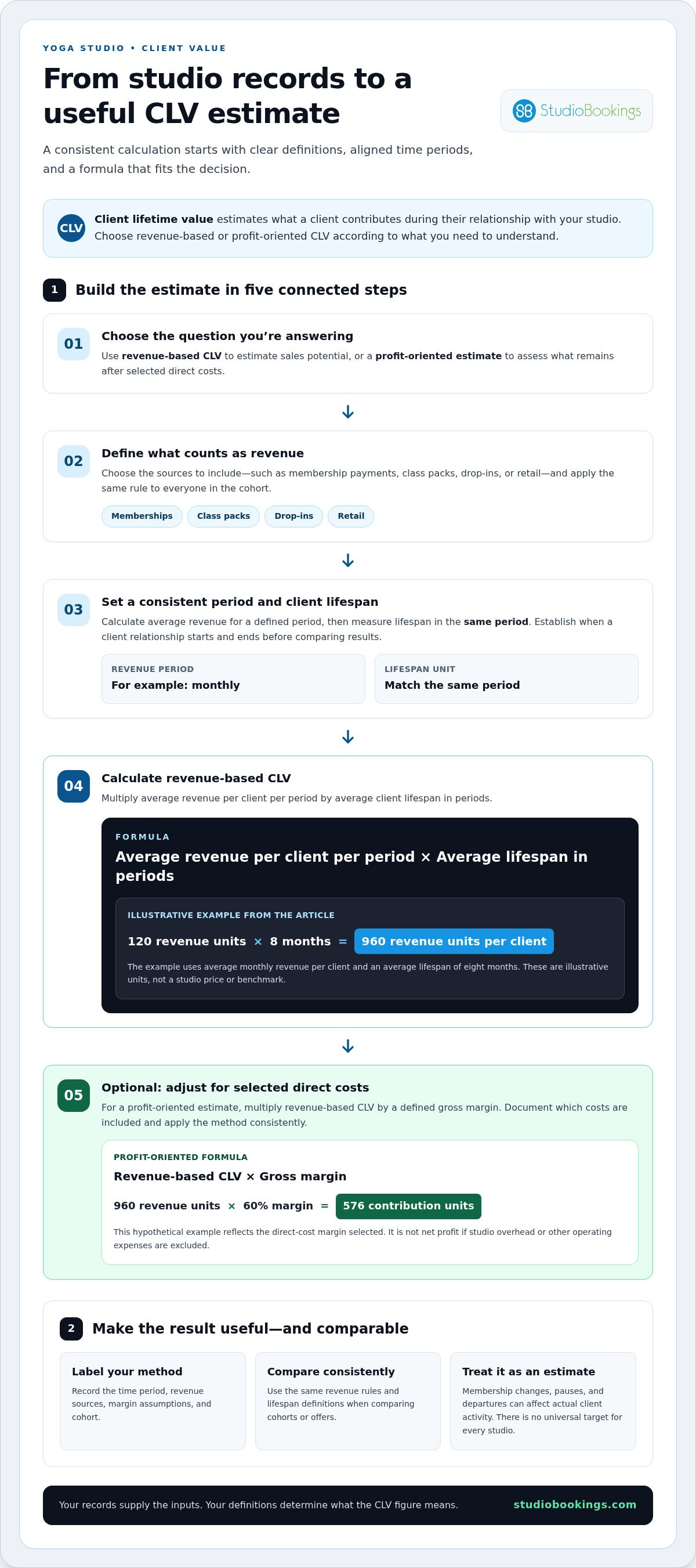
A useful estimate starts with clear definitions, then follows the same clients through the same period. Use this workflow to turn studio records into a number you can inspect and update.
Choose revenue-based CLV or a profit-oriented estimate. Specify which revenue sources and direct costs count.
Group clients who joined during a defined period, and use the same active and lapsed rules for everyone.
Pull membership and payment records for those clients over a consistent observation window. Organize by cohort or membership type when your records support it.
Find average revenue per client per period, multiply it by average lifespan in matching periods, and apply gross margin if calculating contribution.
Check how discounts, refunds, pauses, complimentary classes, and cancellations were treated. Record the method so you can repeat it fairly.
Use records that refer to the same clients and dates. Membership records help establish start, pause, renewal, and cancellation dates; payment records show collected revenue and adjustments. Decide whether revenue is counted when charged or after refunds, and apply that rule consistently. Keep complimentary classes distinct from paid visits, and don’t count a paused membership as active unless your stated definition says to. Studio management records can make these inputs easier to assemble, but they don’t choose the formula for you.
Imagine a fictional cohort with these inputs: average client revenue of 80 units per month, average client lifespan of 10 months, and a gross margin of 55%. The units are illustrative, not studio pricing. Revenue-based CLV is 80 × 10 = 800 revenue units per client. The profit-oriented estimate is 800 × 0.55 = 440 contribution units per client, after the direct costs reflected in that margin.
Now test the assumptions. If average lifespan were eight months instead, revenue-based CLV would be 80 × 8 = 640 units, and contribution at the same margin would be 352 units. If lifespan stayed at 10 months but margin were 45%, the contribution estimate would be 360 units. Small changes in inputs can shift the result substantially, so show the assumptions beside the figure.
CLV is only as reliable as the definitions and records behind its inputs. Recent cohorts may not have completed their client relationships, so their observed lifespan can understate or misrepresent eventual value. Label those estimates provisional. Keep a short note of your cohort dates, revenue rules, cost treatment, and churn definition, then recalculate on a consistent schedule to see whether the pattern changes.
Clear membership and payment records give you a stronger foundation for reviewing client activity over time. Explore StudioBookings for studio management and bring more structure to the information behind your CLV analysis.
CLV is most useful as one part of a broader operating picture. Read it alongside retention, class capacity, and acquisition information. A high client value estimate doesn’t automatically mean a studio is thriving if classes are full, clients aren’t renewing, or the estimate relies on assumptions that no longer fit current operations.
Use segment-level estimates to frame practical questions. If one membership group appears to continue longer than another, look at the experience behind the pattern: booking access, class availability, attendance habits, or how clients are welcomed. Treat the difference as a prompt to investigate, not proof that one group is inherently more valuable. For acquisition decisions, compare spending with a clearly defined profit-based estimate rather than revenue alone. Even then, CLV isn’t a guaranteed return or permission to spend more than the studio can afford.
Choose one small retention change you can evaluate, such as more consistent follow-up when a client’s attendance drops. Define the cohort and observation window before the change begins. Then compare relevant outcomes, such as continued membership or attendance, with a comparable group or an earlier period. Keep other changes in mind when interpreting results; CLV can provide context, but it won’t prove that one action caused a shift.
Calculating CLV is an operating exercise, not just a math problem. The estimate can help you decide what to examine next, while retention and capacity information show whether a change makes sense in practice.
Assign one person to maintain the definitions and source records, and set a recurring review date that suits your planning cycle. Keep a short record of the formula, cohort, observation window, revenue and cost rules, and any assumptions. Use the same approach from one review to the next, or clearly label what changed. Otherwise, a new figure may reflect a new method rather than a real shift in client behavior.
Consistent operational records make that review easier. Organized schedules can help you understand class capacity and attendance patterns; membership and payment records support a clearer view of client activity and revenue. Studio management software provides an operational foundation for assembling those inputs, but you still choose the CLV formula and interpret the result.
For a more consistent way to manage studio schedules, memberships, and payments, explore yoga studio management software. Try StudioBookings’ free trial to see how centralized studio operations can support clearer records for your ongoing CLV reviews.
Choose one business decision you want your CLV estimate to inform, then set a date to revisit it. You might test a small change to the client experience or use the estimate to guide a conversation about class capacity. The aim isn’t to chase a perfect number. It’s to make a considered choice, observe what happens, and refine your approach with better evidence.
To calculate client lifetime value using yoga studio records, consistent operations make it easier to build on what you learn. StudioBookings brings membership, scheduling, payment, and staff management together in one cloud-based platform. Founded by studio owners in 2012, it is designed to support the day-to-day work behind clearer business records. Its free trial and no-contract pricing make it straightforward to explore whether it fits your studio’s workflow.
Start your free StudioBookings trial and take the next step toward a more informed way to plan your studio’s growth.
Multiply average revenue per client over a set period by the average number of those periods the client stays. For example, use monthly revenue with lifespan measured in months. First decide which purchases count and how you’ll treat refunds or pauses. That way, the result reflects a consistent set of studio records rather than a mix of assumptions.
There’s no single CLV figure that’s automatically good for every yoga studio. A useful estimate fits your revenue model, direct costs, retention patterns, and business goals. Compare it with your own earlier cohorts or membership types calculated using the same method. If the figure seems strong but classes are difficult to staff or clients aren’t renewing, investigate those details before treating CLV as a sign of success.
For clients whose relationship has ended, measure the time from their first paid activity to the date they meet your studio’s lapse rule, then average those durations. Decide how to handle a return after cancellation: you might count it as a new relationship or continue the original one, but use the same rule for everyone. Clients still active at the end of your review have incomplete histories, so don’t treat their observed time as a finished lifespan.
Use revenue-based CLV to understand the sales associated with clients, and a profit-oriented estimate to assess the contribution remaining after selected direct costs. The second is more useful for weighing acquisition spending, but only if you can measure its costs consistently. For example, a studio might subtract instructor costs tied to delivered classes while excluding overhead from that calculation. Name the method clearly so readers don’t mistake contribution for net profit.
Yes, but treat the result as an early estimate, not a reliable long-term forecast. Start with the records you have, such as membership start dates and payments, and use a clearly defined group of clients. If you only know their activity over a short period, calculate an observed value for that window and note what’s missing. You can also compare cautious and optimistic lifespan assumptions to see how much uncertainty affects the estimate.
Recalculate it on a regular schedule that matches your planning needs, such as during a recurring business review. Revisit it sooner if you change membership terms, introduce a new offer, or alter how you define an active client. Keep the cohort rules and formula visible beside each result. That helps you distinguish a genuine change in client behavior from a difference caused by new inputs or calculation methods.
It can, if those purchases are part of the value you want to measure and you can link them reliably to individual clients. Decide whether to include class packs, workshops, or both, then apply the same rule to every client in the comparison. Avoid counting a pack’s full sale and the same revenue again as classes are attended. If purchase records can’t be matched consistently, calculate membership CLV separately and label the scope.