What if the best way to plan a profitable Yoga Workshop is to start with what participants will be able to do, feel, or understand by the end? A clear outcome gives your event direction, helps the right students see its value, and makes decisions about timing, content, and promotion easier.It’s natu...

What if the best way to plan a profitable Yoga Workshop is to start with what participants will be able to do, feel, or understand by the end? A clear outcome gives your event direction, helps the right students see its value, and makes decisions about timing, content, and promotion easier.
It’s natural to feel unsure about choosing a topic, filling spaces, or keeping registrations and participant messages organized. You want to deliver a meaningful session without letting logistics take over your teaching time. A focused plan can make the experience welcoming for students and manageable for you.
This guide walks you through building a workshop around one specific promise, shaping a well-paced session, setting practical pricing, and promoting it to the right audience. You’ll also learn how to simplify bookings and communication, then use participant feedback to improve your next event. From the first idea to the post-workshop follow-up, each step helps you create value while keeping the business side on track.
• Shape your Yoga Workshop around one clear theme and a practical outcome for a specific audience.
• Use student questions, your strengths, and gaps in the class schedule to find a topic with a natural fit.
• Map the session into stages so participants know what to expect and the teaching stays focused.
• Plan the venue, accessibility, equipment, registration terms, and participant messages before promotion begins.
• Gather open-ended feedback after the event and use it to refine your next workshop.
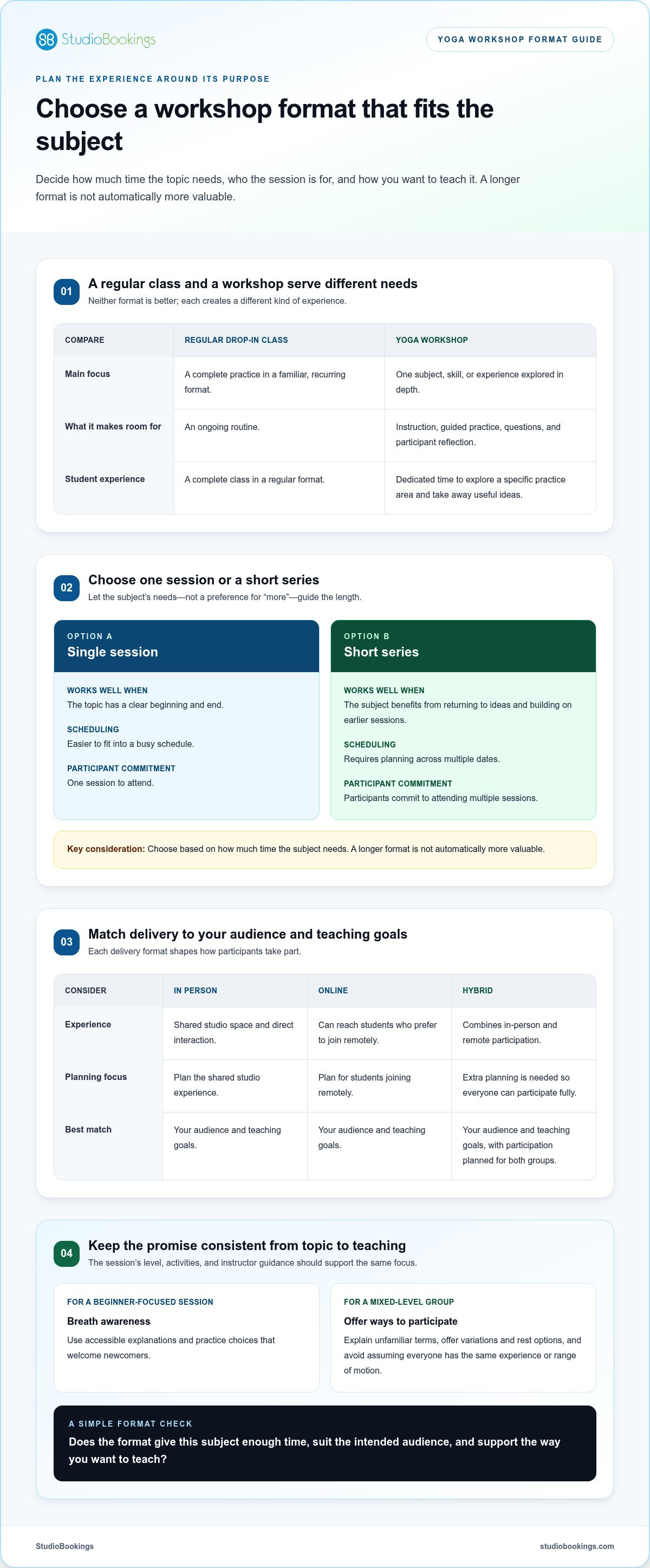
A regular drop-in class usually offers a complete practice in a familiar, recurring format. A workshop gives students more time to explore one theme, skill, or experience in depth. Neither format is better; they serve different needs. A class supports an ongoing routine, while a workshop creates room to examine a specific area more closely.
A yoga workshop is a focused session built around one subject, with time for instruction, guided practice, and participant reflection. That focus helps students understand what they’re signing up for and what they can expect to explore. It also gives you a practical framework for choosing the content, length, teaching style, and price. A clear offer makes it easier to explain the event’s value as part of the wider business of yoga.
Participants get dedicated time to explore a practice area that may receive less attention in a regular class. For example, a session might focus on foundational alignment, breath awareness, or a themed practice such as restorative yoga. Keep the promise specific: students can expect guided exploration and useful ideas to take away, not a guaranteed physical or emotional result.
Make the experience interactive. Invite questions, offer variations, and give students time to notice what they’re learning. A short reflection can help them connect the instruction to their own practice. These elements encourage participants to engage with the topic rather than simply follow a sequence from start to finish.
A single session is easier to fit into a busy schedule and works well when the topic has a clear beginning and end. A short series gives participants more opportunities to revisit ideas and build on earlier sessions, but requires them to commit to multiple dates. Choose based on how much time the subject needs, not on the assumption that a longer format is automatically more valuable.
Delivery matters, too. In-person sessions allow for shared studio space and direct interaction. Online workshops can reach students who prefer to join remotely, while hybrid delivery combines both and calls for extra planning so everyone can participate fully. Match the format to your audience and teaching goals. Then make sure the session’s level, activities, and instructor guidance all support the same promise. A beginner-focused breath awareness workshop, for instance, should use accessible explanations and practice choices that welcome newcomers.
A strong workshop topic sits at the intersection of what students need, what you teach well, and what your schedule doesn’t already cover. Look for recurring questions before brainstorming broad themes. Are students asking how to adapt poses, build a home practice, or make time for mindful movement? Those questions can point to a useful starting place.
Choose a topic where a clear audience need meets your teaching strengths and leads to one practical takeaway. A workshop for runners, for example, could explore yoga movements that fit into a warm-up or recovery routine. Avoid bundling that with unrelated themes such as meditation and yoga philosophy. One audience and one outcome make the event easier to describe, plan, and promote.
Listen before you commit. Keep a note of questions that come up before and after class, then look for patterns. Ask current members what they’d like to explore with a short poll that offers a few specific topic options. You can also invite people to join an interest list before setting all the details.
Use responses as clues, not a promise of attendance. Interest in a topic doesn’t always translate into registrations, so keep testing the idea as you plan. If your subject touches on health, use careful language in your description. The National Center for Complementary and Integrative Health shares research on yoga's benefits, which can help you distinguish evidence-based information from claims your workshop shouldn’t make.
Be clear about who the session is for: beginners, experienced practitioners, or a mixed group. Explain any prerequisites in everyday language. For example, say whether participants should be familiar with common poses, breathwork, or using props. Clear expectations help students decide if the session suits them.
Plan choices into your teaching, too. Offer variations, rest options, and ways to participate without requiring everyone to do the same movement. For a mixed-level session, explain unfamiliar terms and avoid assuming that everyone has the same range of motion or experience. Let the format reinforce the topic: a technique-focused workshop may need more demonstration and questions, while a reflective practice may call for more quiet time.
Once the idea is focused, make it easy to turn interest into a booking. Studio scheduling and booking tools keep class and event administration organized as your plans take shape.
A clear session plan helps students settle in, understand what they’re learning, and move through the practice without feeling rushed. Build the agenda around a progression: welcome participants, set an intention, teach the key ideas, guide practice, allow reflection, then close. Leave room for transitions and questions so the schedule supports the experience rather than competing with it.
Start with introductions, practical information, and a plain-language statement of the session’s focus. Move from accessible preparation into the main instruction and guided practice. End with time to integrate what participants explored and ask relevant questions. Keep questions connected to your topic, and be clear if a related subject falls outside the session’s scope.
Here’s a sample agenda for a 90-minute session. Adjust the timing to suit the subject, group, and amount of practice involved.
| Stage | Purpose | Approximate time |
|---|---|---|
| Welcome | Introduce yourself and share practical details | 10 minutes |
| Intention | Explain the focus and invite participants to arrive | 5 minutes |
| Instruction | Introduce key ideas and demonstrate techniques | 15 minutes |
| Guided practice | Explore the topic with cues and options | 35 minutes |
| Reflection and questions | Allow time to notice, discuss, and clarify | 15 minutes |
| Close | Summarize the session and offer a final pause | 10 minutes |
For a longer session, build in a break. For a shorter one, trim the teaching or discussion without removing the welcome or close. A successful yoga business depends on thoughtful planning as well as strong teaching, and a realistic agenda helps you deliver what you’ve promised.
Tell participants what to bring, what to wear, and what to expect before the event. Share relevant access information in advance, and don’t assume everyone has the same experience, mobility, or familiarity with yoga terms. Clear, steady verbal cues help participants follow along, including when they choose not to look at a demonstration.
Use props to make positions easier to understand, and demonstrate variations rather than presenting one version as the goal. Offer choices for different experience levels, including options to rest or adapt a movement. This keeps the session focused on learning, not on achieving an advanced pose. As you write the agenda, mark where you’ll pause for questions and transitions. Those small buffers make the practice easier to follow and help you stay present with the group.
Good planning makes it easier for participants to book and for you to host. Before you announce your Yoga Workshop, work through the practical details and decide how you’ll handle questions, payments, and changes. Clear information upfront prevents avoidable confusion later.
Choose a time and space that suit the intended audience and session format.
Set attendance based on the space and the support you can provide. Share relevant access details.
List the props and supplies you need, and decide who will handle arrival and attendee questions.
Plan how you’ll communicate a schedule or venue change, or respond if the session needs to be postponed.
State the schedule, cancellation details, what’s included, and what participants should bring.
Keep the booking process simple. Ask only for information you need to manage attendance and share event details. Make registration easy to find from your studio website, email messages, and social posts, and make the next step clear: participants should know how to reserve a place and complete payment.
Send a confirmation after booking, followed by a reminder with the arrival time, location or access instructions, preparation notes, and a way to get in touch with the studio. StudioBookings brings scheduling, member bookings, and payments together in one dashboard, helping you manage workshop registrations and reduce manual attendee administration. The dashboard also gives you a place to coordinate participant information and staff tasks.
Lead with the student need and the specific experience you’re offering, not just a broad title. Explain who the session is for, what participants will explore, and what they’ll need to join. Include the instructor’s relevant experience, session format, agenda highlights, and registration instructions. For example, say that a session is designed for beginners and focuses on exploring foundational alignment, rather than implying it suits everyone or guarantees a particular result.
Share the same core details across your studio website, email, and social channels so people see a consistent offer. Track bookings as they come in and use questions from interested students to spot details that may need clarification. If you’re reviewing the systems behind your studio’s event workflow, see this guide to choosing yoga studio software.
Keep event coordination in one manageable workflow. Explore studio management software for bookings and payments to see how it can support workshop administration alongside your regular schedule.
A smooth event day comes from preparation, not a perfect script. Keep the essentials visible, welcome participants warmly, and stay flexible if the group needs more time or a different option. Afterward, use attendance, feedback, and notes from the day to decide what to keep or adjust for your next Yoga Workshop.
Arrive with enough time to prepare the room, arrange props, check the space, and set up attendance. Make your welcome information easy to find, including where to put belongings and how the session will run. Before starting, introduce the focus and agenda so participants know what to expect.
Check the room, equipment, access arrangements, and check-in list.
Welcome them, mark attendance, and respond to practical questions.
Share the session focus, key expectations, and options for participating.
Keep an eye on timing while leaving room for transitions and relevant questions.
Have a simple approach for late arrivals, access needs, or an unexpected schedule change.
Use the agenda as a guide, not a rigid script. If a discussion runs long, decide in advance which activity can be shortened without losing the session’s main purpose.
Invite feedback soon after the session, while the experience is fresh. Ask open questions, such as “What helped you learn?” and “What would you change for next time?” You can also ask about the content, pacing, accessibility, and overall experience. Avoid questions that imply a preferred answer, such as asking whether participants enjoyed a specific activity.
Review responses alongside registrations and attendance. Did the people who came match the intended audience? Did the session deliver the takeaway you described? Note any operational friction, such as unclear arrival instructions, check-in delays, or a schedule that felt rushed. Separate one-off comments from repeated themes before making changes.
For recurring events, consistent records make it easier to spot patterns across bookings, attendance, payments, and staff coordination. StudioBookings keeps scheduling, payments, member bookings, and staff management together in a centralized dashboard. Explore this software guide for yoga studios for ideas on connecting event administration with your wider studio workflow. Use what you learn to refine the next event, not to change everything at once.
A profitable Yoga Workshop starts with a clear promise: choose a topic that meets a real student need, shape the session around a practical takeaway, and make booking and event details easy to follow. On the day, focus on a welcoming experience. Afterward, use attendance and open-ended feedback to refine the next one.
The admin matters, too. Clear booking, payment, and staff workflows help keep participant information and event tasks organized, leaving you more room to focus on teaching. StudioBookings was founded by studio owners in 2012 and provides cloud-based tools for scheduling, memberships, payments, staff, and member bookings.
Explore StudioBookings to see how organized studio management can support your workshop plans.
A yoga workshop is a focused session built around one theme, skill, or experience, with time to explore it more deeply than a typical drop-in class. It may combine instruction, guided practice, questions, and reflection. For example, a workshop might focus on foundational alignment or breath awareness. A clear topic and takeaway help participants understand what the session covers and whether it fits their interests and experience.
Plan a beginner workshop around one approachable topic and explain what participants will learn in plain language. Avoid assuming familiarity with pose names, breathwork, or props. Use clear demonstrations, offer variations and rest options, and leave time for questions. Tell participants what to bring and what to expect before they book. A simple agenda that moves from welcome to instruction, guided practice, reflection, and close helps newcomers follow along.
Choose a duration that gives the topic enough room without adding content just to fill time. A focused specialty session might run for 90 minutes, while a deeper exploration could take two to three hours. A half-day format suits a broader immersion, but requires breaks and more detailed logistics. Work backward from the learning outcome, then allow time for welcome, instruction, practice, questions, and a clear close.
Set your price by weighing preparation and teaching time, venue and equipment costs, payment fees, and expected attendance. As a starting benchmark, a 90-minute specialty workshop may be priced at $25-$45 per person, while a two-to-three-hour session may be $35-$75. Estimate your break-even attendance, then choose a price that fairly values your expertise and feels appropriate for the audience and experience.
Yes. An online workshop can work well if the topic is suited to remote instruction and you plan for clear demonstrations and participant questions. Share the meeting link, start time, equipment needs, and guidance on camera use in advance. Test your audio, camera angle, and internet connection before the event. Keep the practice space and props in mind, and offer variations participants can follow safely at home.
Tell participants what to bring in their booking confirmation and reminder. Depending on the session, this may include a yoga mat, water, comfortable clothing, and any props you want them to use, such as blocks or a strap. Say whether props are provided or whether participants should bring their own. Include practical details such as arrival instructions and anything specific to the venue or online format.
Set a minimum attendance level and a decision date before promoting the event, based on your costs and capacity. If bookings fall short, review registrations against that threshold and follow the cancellation or rescheduling terms you shared with participants. Communicate the decision promptly and explain the next steps, such as a new date or any applicable refund process. Avoid waiting until the last minute to tell attendees.
Use a straightforward booking process that shows the schedule, price, cancellation terms, and participant expectations before checkout. Collect only the details you need to manage attendance and communicate event information. Send a confirmation and reminder with arrival or access instructions. StudioBookings brings scheduling, member bookings, and payment processing together in one dashboard, helping reduce manual admin and coordinate staff and event tasks.