
What if your studio’s average revenue per member looks healthy only because you’re counting members inconsistently? The average revenue per member fitness studio owners track is useful only when the revenue streams and member count match the question they want to answer. A figure based on membership...

What if your studio’s average revenue per member looks healthy only because you’re counting members inconsistently? The average revenue per member fitness studio owners track is useful only when the revenue streams and member count match the question they want to answer. A figure based on membership fees alone, or on a changing mix of active and inactive members, can point you toward the wrong decision.
It’s understandable to want one clear number when revenue changes month to month and members have different plans or class habits. To make the metric useful, define the revenue you’ll include, decide which members count, and apply those rules consistently every time you compare results.
This guide explains how to calculate average revenue per member, interpret the result without misleading comparisons, and use it to inform decisions about recurring studio revenue. You’ll also learn how to compare plans, class types, and time periods fairly. Keeping membership and payment records together can make regular reviews easier, but the metric still depends on sound, consistent accounting.
• Use a clearly defined reporting period and matching member count to calculate the average revenue per member fitness studio owners can reliably track.
• Compare plans, member segments, and time periods using the same calculation rules to spot meaningful differences.
• Investigate what changed before adjusting prices, packages, or class schedules in response to a shift in the metric.
• Set a regular review cadence and document your calculation method so your team can interpret results consistently.
• Keep membership and payment records organized to make recurring revenue reviews easier and more consistent.
To find out how much revenue each member represents on average, divide revenue for a defined period by the matching member count. For example, if a studio records 240 revenue units across 60 members in a month, its average is 4 units per member. The figures are illustrative. The key is to use the same period and the same definition of who counts as a member.
This average does not mean that every member pays or generates the same amount. One person may pay for a recurring membership, another may buy add-ons, and someone else may attend less often. The average revenue per member fitness studio owners track is a Key Performance Indicator (KPI), but it should be considered alongside other measures, not treated as a complete picture of studio health.
When you track it consistently, the metric can show whether average member value is rising, falling, or holding steady. A change may reflect a shift in membership mix, pricing, add-on purchases, or recurring revenue. It can help you ask more focused questions about pricing and plan design and support recurring-revenue planning.
The figure won’t tell you why it changed, or whether revenue is profitable after operating costs. Review it alongside retention and costs. Higher average revenue may look positive, but it doesn’t necessarily mean the studio is healthier if members are leaving or expenses are rising.
Revenue per class measures income associated with a particular session. Revenue per member measures revenue associated with your member base over a chosen period. They answer different questions. A class may be well attended, but its revenue depends on factors such as capacity and how attendees access it, including whether they use a membership or book separately.
For example, a member with broad class access may attend several sessions without each visit representing a separate payment. Looking only at class revenue can miss the value of that ongoing relationship. Looking only at member revenue can hide whether particular sessions are using capacity effectively. Use each measure for its own purpose, and don’t treat them as interchangeable.
Average revenue per member equals the studio revenue you define for a reporting period divided by the matching number of members counted for that same period. State the rule you use for the denominator, such as active paying members. Don’t assume it means every account in your system.
Choose a reporting period first, such as a calendar month, then use the same start and end dates for revenue and membership records. Keep your revenue definition consistent across periods so a change in the result reflects studio activity, not a change in what you counted.
Hypothetical monthly example: A studio records $12,000 in membership payments, $1,200 in drop-in bookings, $800 from workshops, and $500 in retail sales during April. It counts 100 active paying members during that same period. Including all four revenue categories, the calculation is ($12,000 + $1,200 + $800 + $500) ÷ 100 = $145 per member. These figures illustrate the method, not an industry benchmark.
For a broad view of member-related studio revenue, you might include recurring membership income, drop-ins, workshops, retail, and other studio sales. For a membership-only view, count recurring membership income alone and label the result clearly. Gymdesk, citing the Health & Fitness Association, reports an average of $517 per year in annual value per member. Treat this as a reference point, not a direct comparison unless your revenue scope and member definition match.
Document how you handle discounts, refunds, taxes, and one-off fees. Decide, for example, whether you record revenue before or after discounts and refunds, and whether you exclude taxes collected. Comparisons become unreliable when these rules change from one month to the next.
Active paying members are often useful when you want to understand revenue from current paying customers. All registered accounts answer a different question: how much revenue is associated with everyone in your database, including people who may not currently pay. If you change denominators, label the metric accordingly.
Write down how you treat paused, cancelled, complimentary, and trial memberships. A paused member may remain registered without generating current payments; a trial member may be active without paying. Choose the treatment that fits your question, then apply it consistently using membership records from the same dates as your revenue period.
Organized payment and membership records make these definitions easier to apply during regular reviews. A studio management dashboard, such as StudioBookings studio management software, can bring those records together for review. Use your accounting process to confirm the revenue figures.
A comparison is useful only when the calculations are comparable. Keep revenue categories, member definitions, and reporting dates consistent. If one month includes workshop sales and another counts membership income only, the averages won’t show a like-for-like change.
Studio models also differ. A class-based studio with several membership options won’t necessarily produce a directly comparable figure to a facility with a different service mix. The Health & Fitness Association’s 2025 Fitness Industry Benchmarking Report offers industry context, but use external benchmarks cautiously. Check that the business model and calculation method are similar before treating a benchmark as a target.
Where your records allow, review unlimited, limited-class, introductory, and other plans separately. You can also compare new, established, and returning members to see how average revenue differs among groups. These patterns describe what you observe; on their own, they don’t explain why the differences exist.
Protect member privacy by sharing group-level results rather than individual details. Avoid drawing conclusions from very small groups, where one unusual account can dominate the average.
| Comparison | Keep consistent | Useful question |
|---|---|---|
| Membership plans | Revenue rules and period | How do plan averages differ? |
| Member segments | Segment criteria and member count | How do new and established groups compare? |
| Reporting periods | Revenue categories and dates | Is the change sustained or temporary? |
Use month-over-month comparisons to monitor recent movement and year-over-year comparisons, where records permit, to account for recurring seasonal patterns. Note pricing changes, promotions, closures, workshops, and membership freezes alongside the results. A promotion may temporarily shift revenue or the member count. A freeze can change the active-member denominator even if registered accounts remain on file.
Pair each comparison with active membership and attendance trends. If average revenue rises while active membership falls, investigate before making a change. If it drops during a promotion, check whether the effect continues after the offer ends. Clear notes and consistent records help you interpret the average revenue per member fitness studio owners track without mistaking a short-term fluctuation for a lasting trend.
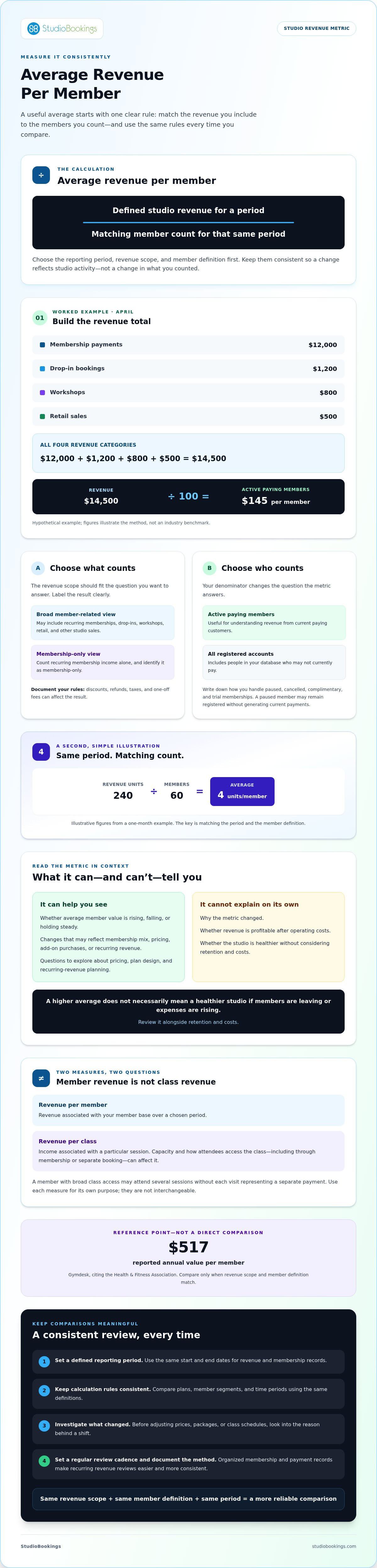
A useful metric should lead to better questions, not snap decisions. Set a regular review cadence, such as monthly, and document the revenue rules and member definition your team uses. This gives everyone the same basis for interpreting a change. To put the average revenue per member fitness studio owners track into context, review it alongside retention, attendance, class capacity, and operating costs.
Before changing prices, packages, or the class schedule, check what moved in the underlying data. Did the member mix change? Did attendance or capacity shift? Were there more freezes, refunds, or discounts? A lower average can have several causes, so treat it as a signal to investigate rather than proof that one particular change is needed.
Start with cancellations and pauses, then review discounting and changes in plan mix. Check attendance too: members may be using fewer classes, and capacity patterns can help show whether sessions are being filled. Confirm that refunds or payment timing weren’t recorded differently during the period. These checks help narrow down possible explanations before you adjust a package or schedule.
Look for a shift toward higher-value plans or additional purchases, but check whether the member count fell or the reporting scope narrowed. Either can lift the average without indicating broader improvement. Review retention and member experience alongside the increase. If members are leaving or engagement is weakening, a higher figure alone isn’t a reason to celebrate or raise prices.
Once you’ve identified a likely driver, make changes deliberately and see whether the pattern continues in later reviews. Keep the metric in perspective: it helps you assess revenue trends, while retention, capacity, and costs help show what those trends mean for the studio. For more operational context, see this boutique studio management guide.
Consistent records make reviews easier to repeat. Explore studio management software to see how membership and payment information can be reviewed together. Use the figures as an operational aid, not a replacement for sound accounting or careful judgment.
A useful calculation depends on reliable records and a repeatable process. When membership details and payment information are stored separately, monthly reviews can become slow and inconsistent. A clear workflow helps you apply the same reporting rules each time and distinguish changes in studio activity from changes in how you counted.
Before calculating, set the reporting period, choose which revenue streams to include, and define which members count. Record the result alongside the member count, retention, attendance, and revenue by stream. Add notes about pricing changes or promotions so your team has context for interpreting movement.
Keep the routine consistent from one review to the next. If you change a definition, document the change. Don’t treat the new figure as directly comparable with earlier results unless you recalculate them using the same rules. The yoga business software growth guide offers related planning context for studios looking to organize operations as they grow.
A management dashboard can bring membership and payment records together, reducing reliance on scattered manual tracking. StudioBookings supports scheduling, memberships, payments, and staff management in one dashboard. Owners can review relevant operational information in a more organized workflow while still checking revenue figures against their accounting records.
For a smaller operation, the small-studio software guide can help you consider what to look for in a system. The goal is not simply to produce an average revenue per member fitness studio figure. It’s to make the calculation consistent enough to use alongside other measures in routine decisions.
If you’re ready to explore a management system for your studio, explore StudioBookings and start a free trial. A consistent workflow supports clearer reviews, but software doesn’t replace sound accounting or a well-defined method.
The average revenue per member fitness studio owners track is most useful when its revenue scope and member count are clearly defined. Keep those rules consistent across reporting periods and compare like with like across plans and member segments. The result is an average, not a verdict on each member or the studio’s profitability.
Use changes as prompts for investigation. Check membership mix, promotions, attendance, and payment timing, then consider the metric alongside retention, capacity, and operating costs before adjusting prices or schedules. A regular review based on reliable records gives you a stronger basis for decisions.
StudioBookings brings scheduling, memberships, payments, and staff management together in one dashboard to help you review key studio records in a consistent workflow. Explore the platform with a free trial and no-contract pricing. Explore StudioBookings and start your free trial.
Clear definitions and steady reviews can turn a single metric into a practical tool for growth. You have a solid starting point for your next studio decision.
There isn’t one universal average revenue per member fitness studio figure: 2026 benchmarks vary by gym type. VERVE Pulse 2026 and Exercise.com report monthly averages of $110 for boutique studios, $72 for mid-range gyms, and $49 for budget gyms. Treat these as broad reference points, not targets for every studio. Your result may differ based on the revenue included, member-count rules, membership mix, and studio model.
Divide the revenue you’ve defined for a reporting period by the matching member count. For a monthly figure, use revenue and member data from the same month, and state whether the denominator is active paying members or another group. For example, if defined revenue is $9,000 and the count is 75 active paying members, the average is $120 per member for that month. Keep the method consistent when comparing periods.
Choose revenue categories that fit the question you want to answer. A broad studio-revenue view might include membership income, drop-ins, workshops, retail, and other studio sales. A membership-only calculation should include membership income alone and be labeled accordingly. Also document whether discounts, refunds, taxes, and one-off fees are included. Apply the same rules each period so changes in the result reflect performance, not a change in accounting scope.
Use active paying members to assess revenue against the current paying membership base. Count all registered accounts when you want to understand revenue relative to everyone in your database, including people who may not currently pay. Neither denominator is right for every purpose; they answer different questions. Note how you treat paused, cancelled, complimentary, and trial memberships, and align the member count with the dates covered by revenue.
Your figure can differ because studios don’t always share the same revenue scope, member definition, or business model. A benchmark might include additional revenue streams or use a different member count than your calculation. Plan mix, promotions, and seasonal activity can also affect your result. Before comparing, confirm the benchmark’s period and methodology where available, then compare like with like rather than treating an industry average as a required target.
Start by identifying what drives your current result. Review membership tiers, attendance, retention, and revenue from workshops or other studio sales. Consider whether plan options or relevant add-ons could better serve member needs, but don’t rely on upselling alone. Track changes over time and monitor member experience, retention, and operating costs too. A higher average is more useful when it supports sustainable revenue without weakening the member relationship.
A monthly review gives you a regular view of movement and a consistent basis for comparing reporting periods. Set the reporting dates, revenue scope, and member definition before calculating, then note changes such as promotions or pricing updates. Pair the result with retention and attendance trends. If seasonal patterns affect your studio, compare the same months across years when records allow instead of relying only on month-to-month movement.