
What if your busiest Pilates classes aren’t the ones doing the most for your studio’s health? A packed schedule can hide weak retention, uneven attendance, or revenue that doesn’t match the effort behind each class. The right key performance indicators for a pilates studio help you see what’s workin...

What if your busiest Pilates classes aren’t the ones doing the most for your studio’s health? A packed schedule can hide weak retention, uneven attendance, or revenue that doesn’t match the effort behind each class. The right key performance indicators for a pilates studio help you see what’s working and where to make a change.
If you’re unsure whether you’re using class capacity effectively or how membership changes affect revenue, you’re not alone. Tracking more numbers won’t help unless each one answers a practical question. A focused set of KPIs can make studio performance easier to understand without turning your week into a spreadsheet exercise.
This guide explains which Pilates studio KPIs to track, how to calculate them, and how often to review them. You’ll look at class fill and attendance, membership and retention, and financial measures such as recurring revenue and revenue per member. Then you’ll connect the results to decisions about scheduling, memberships, and operations. Organized booking, payment, and staff information can make it easier to gather the inputs you need. The goal isn’t to chase a perfect number. It’s to use consistent, relevant data to choose your next step with confidence.
• Choose key performance indicators for a pilates studio that connect directly to business goals, rather than tracking numbers without a clear purpose.
• Use consistent definitions and time periods when calculating attendance, class utilization, and client retention.
• Compare each KPI with your own studio’s trends, then investigate what may explain a change before deciding what to adjust.
• Separate weekly operating checks from monthly business-health reviews, and finish each review with a clear next step.
• Organize booking, attendance, membership, payment, and staff records to make KPI reviews easier to carry out.
You may have booking totals, attendance records, membership counts, and revenue figures at your fingertips, yet still be unsure what they say about your studio’s health. Numbers become useful when they answer a clear business question. The right key performance indicators for a pilates studio connect the information you collect to decisions you can act on.
A studio KPI is a measurable indicator tied to a specific business goal that helps you decide what to do next. This reflects the purpose of a Key Performance Indicator (KPI): measuring progress toward an intended result. A total of 200 bookings, for example, is a raw figure. On its own, it doesn’t show whether more people are attending, classes are filling, or members are returning. Compare attendance with the available class spaces, and the figure becomes more useful for assessing your timetable.
A useful metric points toward a decision. If bookings are rising but attendance isn’t, review cancellations, reminders, and booking patterns before adding classes. If members are attending less often, investigate whether a follow-up is needed. The number doesn’t make the decision for you. It helps you see where to look.
It also helps to distinguish leading indicators from lagging indicators. Bookings for upcoming classes can signal likely demand, while collected revenue shows what has already been earned. Consider both: an encouraging booking trend doesn’t automatically mean revenue has increased, and revenue alone may not reveal an emerging attendance problem.
Start with a connected set of measures, not an endless list. Each area offers a different view of performance:
Show how available class spaces are being used and whether people who book actually attend. Together, they help you assess class times and scheduling decisions.
Reveal whether clients continue attending, renew, or change how they participate. A shift in activity can prompt a timely check-in.
Adds financial context. Pair it with membership activity to understand whether changes in member behaviour are reflected in income.
Shows how teaching hours are distributed alongside class demand. A timetable can look busy overall while demand and teaching hours remain uneven.
These measures work best as a set. Low attendance in a class, for example, is more informative when considered alongside its capacity, schedule, and instructor workload. Choose a small group of KPIs that supports real decisions, then use consistent records to review them over time.
Formulas are useful only if you count the same things each time. Set a clear measurement period, use consistent definitions, and compare like with like. A reformer class with limited equipment capacity shouldn’t be interpreted as if it had the same number of available spaces as a mat class. Class format, instructor, timetable, and actual capacity all affect what a result means.
For a set period, calculate attendance rate as attended bookings ÷ available class places × 100. If a reformer class offers 8 places in a given week and 6 booked clients attend, its attendance rate is 75%.
Define “available class places” before you start. Count the spaces that could actually be booked in sessions that ran. Exclude cancelled sessions, and decide how to handle places released after a client cancels. For example, you might count a released space as available if another client could book it. Apply the same rule every time.
Review the figure by class, time slot, format, and instructor when your records allow. A studio-wide average can hide a busy evening class and a quieter daytime one. If you change equipment capacity or the timetable, note the change so you can interpret the result fairly.
Choose a starting group and a defined period. For example, member retention rate = members from the starting group still active at the end of the period ÷ members in the starting group × 100. If 40 members are active at the start of a month and 36 of that same group remain active at month-end, retention is 90%.
Define “active” consistently. Decide how you’ll treat membership pauses, failed payments, and members who switch plans. To measure churn, divide cancellations during the period by active members at its start, then multiply by 100. State whether cancellations are counted on the request date or membership end date, and keep that rule fixed.
Track trial-to-membership conversion separately from ongoing retention. One measures how many trial clients become members; the other shows whether existing members continue. They describe different stages of the member journey, so combining them can obscure where follow-up may be needed.
There’s no single benchmark that fits every Pilates studio. Compare each result with your own past periods, using the same definitions and noting changes in capacity, class format, or schedule. Organized booking and membership records make those comparisons easier to assemble. If you’re considering software to bring studio information together, explore Pilates studio management software as one option.
A KPI can look strong in isolation and still hide a problem. High revenue per class, for instance, may come from premium pricing even as attendance falls. Compare related measures and ask what could explain the pattern. The most useful key performance indicators for a pilates studio reflect its own setup, not an assumed industry-wide target.
| KPI | What it reveals | Useful next question |
|---|---|---|
| Class utilization | How much of the available capacity is being used | Are quieter classes concentrated in a certain time slot or format? |
| Revenue per class | Income generated by each class | Does revenue align with attendance, capacity, and class pricing? |
| Member retention | Whether members from a defined group stay active | Has attendance changed among members who remain enrolled? |
| Instructor workload | How teaching hours are distributed across the schedule | Does the workload match class demand and the timetable? |
Read revenue per class alongside attendance and available capacity. If revenue holds steady while attendance drops, pricing or membership mix may be influencing the result. If attendance is high but revenue is weaker than expected, review how clients are paying and whether you include the same revenue sources each time.
Retention also needs context. Members can remain active while attending less often, so check attendance patterns alongside retention for possible changes in engagement. Segment results by class type, instructor, or membership option only when there’s enough activity to make the comparison meaningful. Small groups can make a few individual choices look like a broad trend.
Studios differ in location, pricing, class size, equipment, and timetable. A small reformer class and a larger mat class don’t have identical capacity. A schedule built around peak evening sessions may also behave differently from one with more daytime classes. One target can’t account for all those factors.
Choose a consistent starting period and compare future results against it. Note seasonal patterns, timetable or capacity changes, and one-off disruptions, such as a class cancellation. Otherwise, you could mistake a temporary shift for a lasting change in performance. If you compare different class formats, use consistent definitions and interpret each format on its own terms.
Use the example calculations in this article to understand how to measure each KPI, not as recommended industry benchmarks. Your own history gives you a more relevant reference point. Review patterns across connected measures, then investigate before changing a class, schedule, or membership option.
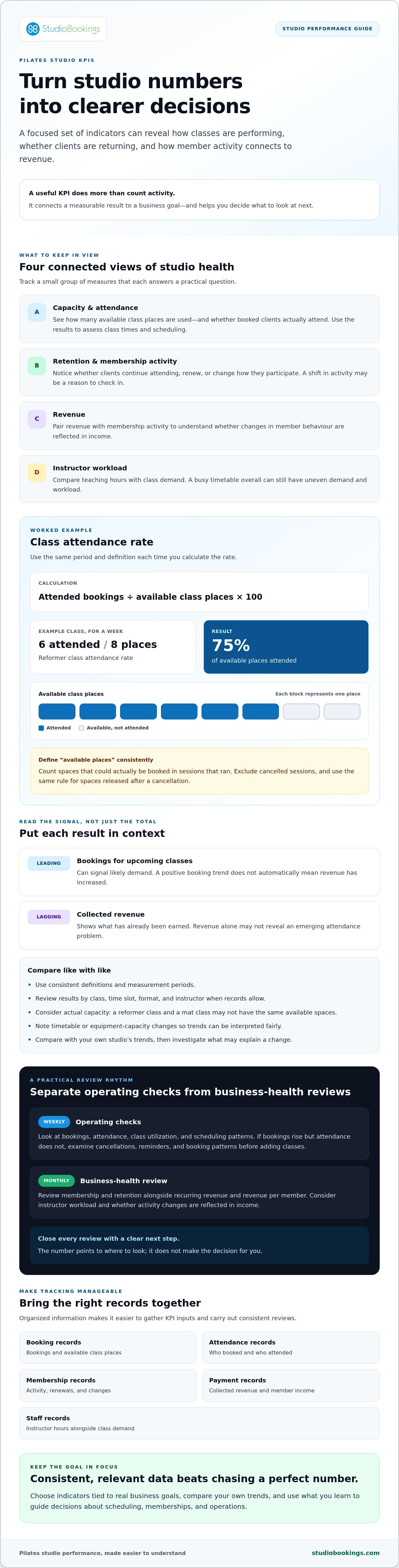
A useful KPI review doesn’t need to become another full-time task. Keep a small scorecard and follow the same sequence each time: collect, compare, investigate, decide, and revisit. Gather the records, compare them with the same studio’s previous results, investigate meaningful changes, choose an action, then check whether it helped. Track a metric only if it supports a decision.
Use weekly checks to spot operational changes while there’s still time to respond. Review bookings, attendance, waitlists, cancellations, and class capacity by session. Note schedule adjustments, instructor changes, or cancelled classes alongside the figures so an unusual result has context.
Keep the follow-up simple. If a class has fewer attendees than usual, check whether bookings also fell or cancellations rose. Then assign one next step and an owner, such as reviewing the class time or checking in with affected members. A number without a follow-up is just a record, not a review.
Monthly reviews give you a broader view of business health. Consider active memberships, retention, trial-to-membership conversion, collected revenue, and operating patterns such as class demand and instructor workload. Compare the current period with previous periods using the same definitions. If you changed a membership policy or timetable, record it before interpreting the trend.
Organized booking, attendance, membership, payment, and staff information can make it easier to gather the inputs for this review. Studio management software may help keep those records together, but check which data you can access and how it can be reviewed before choosing a tool. For background on evaluating these options, consult the Pilates Studio Management Software: The 2026 Definitive Guide.
Keep the scorecard focused. If a KPI hasn’t prompted a question or decision over several reviews, consider whether it belongs there. The key performance indicators for a pilates studio should help you understand what’s changing and choose a practical response, not create a longer list to maintain.
Gather the same records each review.
Use consistent definitions and time periods.
Look for context behind changes.
Assign one clear action and owner.
Check what happened after the action.
Want to bring scheduling, memberships, payments, and staff information together? Explore StudioBookings studio-management tools as you plan a repeatable KPI review.
Before choosing software to support KPI tracking, identify the source records your review depends on. You may need class schedules and bookings to examine demand, attendance records to compare booked and attended places, membership activity to review retention, payment records to assess collected revenue, and staff information to understand instructor workload.
The right setup can make these records easier to organize and gather. But don’t assume a platform automatically calculates every metric you need. The key performance indicators for a pilates studio still depend on clear definitions, consistent review periods, and your interpretation of the results.
Use this checklist when comparing options. Ask whether the system organizes the records you need, then confirm how you can review or retrieve them:
• Are class schedules, bookings, attendance, memberships, payments, and staff records accessible?
• Can you filter information by date, class, instructor, or membership type?
• Are relevant reports or exports available, and what information do they include?
• Can owners access the information they need through a mobile app?
Verify each capability directly with the provider. In particular, check whether attendance data, filters, reports, exports, and mobile access work the way your review process requires. A feature list alone may not show whether you can consistently compare the periods or segments that matter to your studio.
StudioBookings provides cloud-based Pilates and studio management software, with class scheduling, memberships, payments, and staff management handled from one dashboard. These functions relate to source information for reviewing schedules, member activity, revenue, and instructor workload. The platform also includes a mobile app for owners and members. Confirm directly which reports, exports, attendance records, and filtering options are currently available before relying on them for a particular KPI.
Start by listing the metrics you plan to review, then check that the system gives you access to the underlying records and time periods you need. For a broader look at choosing operational tools, read the Pilates Studio Management Software guide.
If the platform’s functions fit your workflow, explore StudioBookings and start your free trial. Its scheduling, membership, payment, and staff-management tools can help you assess whether the platform suits your studio’s measurement routine.
The best key performance indicators for a pilates studio aren’t just figures to collect. They help you connect class capacity and attendance with membership behaviour and revenue, then choose a practical next step. Calculate metrics using consistent definitions, compare them with your own past results, and look at related measures together before making changes.
Keep your review manageable. Check bookings, attendance, cancellations, and capacity regularly, then use a monthly review to assess memberships, retention, trial conversion, and collected revenue. A short scorecard with clear follow-up beats a long list of numbers that never informs a decision.
StudioBookings is built for Pilates and other fitness studios, with scheduling, memberships, payments, and staff management in one dashboard. These tools can help keep useful source information organized as you build your review routine. Explore the platform and its free trial with no-contract pricing to see whether it fits your studio’s needs. Explore StudioBookings and start your free trial.
You don’t need perfect data to begin. Choose a few useful measures, review them consistently, and let each finding guide your next step. Your studio’s performance will become clearer one practical decision at a time.
The most useful key performance indicators for a pilates studio connect class capacity, member behaviour, and financial health. Start with class utilization or attendance, member retention, active memberships, trial-to-membership conversion, and collected revenue. Add measures such as revenue per member or instructor workload if they answer a specific question. Choose a manageable set, define each metric clearly, and use the results to guide decisions rather than tracking numbers for their own sake.
Divide attended bookings by available class places for a defined period, then multiply by 100. For example, if 6 clients attend a class with 8 available places, utilization is 75%. Define available places consistently: include sessions that ran, account for places released after cancellations, and exclude cancelled sessions. Compare similar class formats and time slots where possible, since equipment limits and class capacity affect how you interpret the result.
There isn’t one utilization rate that defines a healthy Pilates studio. Class format, equipment, capacity, pricing, location, and timetable all affect the result. Instead of treating a generic target as a pass or fail, establish a baseline using consistent definitions and compare each class with its own history. If utilization changes, check bookings, attendance, cancellations, and schedule changes together before deciding whether to adjust a class.
Choose a starting group and a fixed period, then divide the number of those members still active at the period’s end by the number in the starting group. Multiply by 100 to get the retention rate. Define “active” and decide how to treat paused memberships or plan changes. Track trial-to-membership conversion separately, since it measures new-client sign-ups rather than whether existing members continue.
Useful financial measures include collected revenue, monthly recurring revenue from memberships, revenue per member, and revenue per class. Each answers a different question: recurring revenue shows membership income, while revenue per class puts earnings in the context of the timetable. Pair financial measures with attendance and membership activity to understand what may be driving changes. Use consistent periods and include the same revenue sources each time you compare results.
Studio management software can organize source records that support KPI reviews, such as schedules, bookings, memberships, payments, and staff information. Whether it calculates or reports specific KPIs depends on the platform’s capabilities. Before choosing software, confirm which records you can access, whether they can be filtered by date or class, and what reports or exports are available. StudioBookings provides scheduling, memberships, payments, and staff management from one dashboard.
Review operating measures weekly and broader business-health indicators monthly. A weekly check can cover bookings, attendance, cancellations, waitlists, and class capacity. A monthly review can look at active memberships, retention, trial conversion, collected revenue, and operating patterns. Keep the measures and time periods consistent, note unusual changes, and finish each review with a clear next action. This rhythm helps you catch operational shifts without turning KPI tracking into a daily reporting burden.